You write a sentence about a tree. You pause. Is it “leaves” or “leafs”? This small choice can cause big doubt. Many writers, students, and bloggers search for this answer every day.
They want to be correct. They want clear writing.
This confusion happens because English has many plural rules. Most words just add -s. But some words change more. The word “leaf” is one of them.
Sometimes it becomes “leaves.” Other times, “leafs” is also correct. This makes people unsure.
You may see “leaves” in nature writing. You may see “leafs” in sports or books. Both exist. But they do not mean the same thing.
This guide will give you a quick answer first. Then it will explain the history, spelling rules, and real examples.
You will also see tables, tips, and common mistakes. By the end, you will know exactly when to use “leaves” or “leafs.” Your writing will be correct and confident.
Leaves or Leafs – Quick Answer
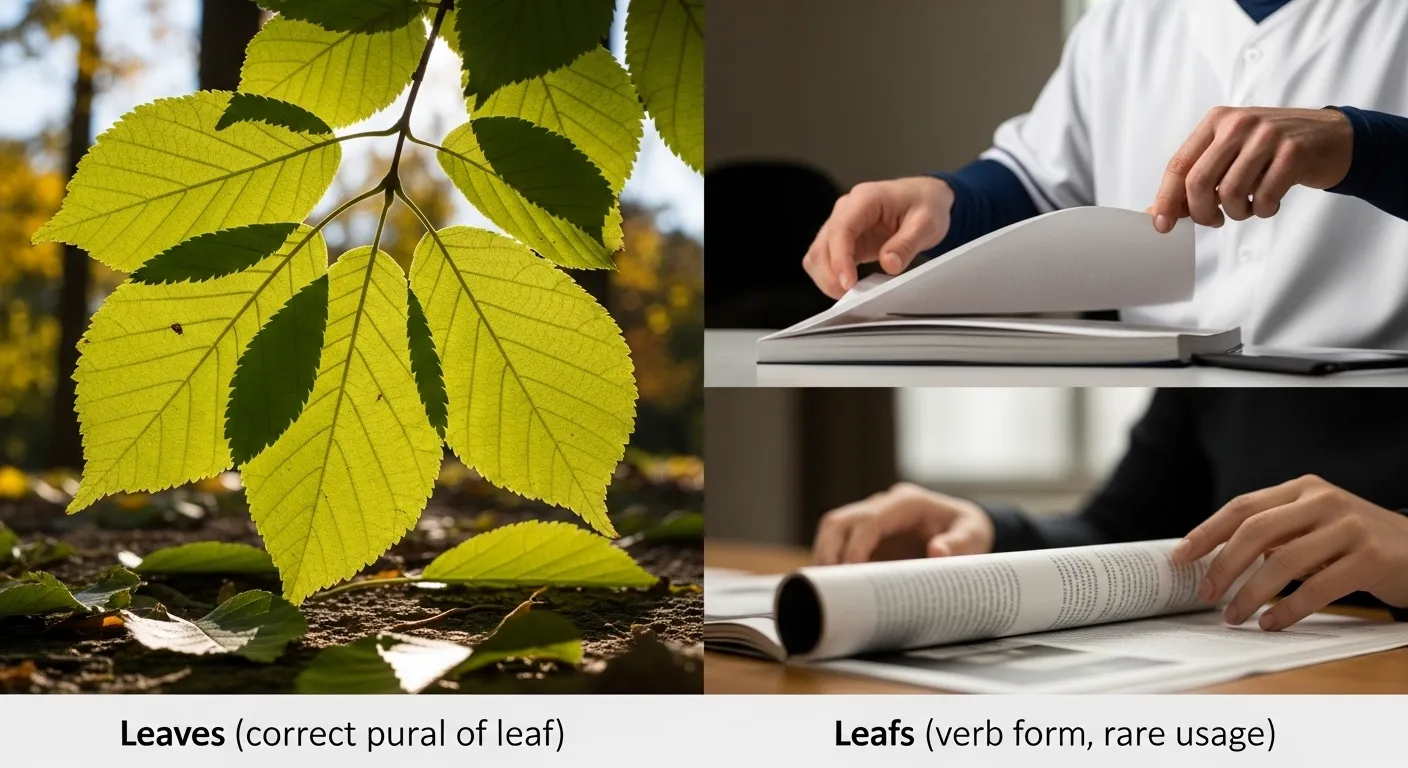
Quick answer: “Leaves” is the correct plural of “leaf” in most cases. “Leafs” is used in special cases, like names and verbs.
Use “leaves” for plants and nature:
- The tree has green leaves.
- Autumn leaves fall fast.
- The wind moves the leaves.
Use “leafs” mainly as a verb or proper name:
- He leafs through a book.
- The hockey team is the Toronto Maple Leafs.
Simple rule:
- Nature → leaves ✅
- Verb or name → leafs ✅
- Nature → leafs ❌
The Origin of Leaves or Leafs
The word “leaf” is very old. It comes from Old English “lēaf.” Long ago, English used many irregular plurals.
Words ending in -f often changed to -ves in plural.
Examples:
- leaf → leaves
- wolf → wolves
- knife → knives
This pattern came from sound changes in early English. Over time, people kept these forms.
Major dictionaries like Merriam-Webster and Oxford English Dictionary confirm that “leaves” is the standard plural for plant leaf.
The word “leafs” came later. It formed from the regular rule of adding -s. English allows both patterns. But each has its own use.
So history created two forms:
- leaves → natural plural
- leafs → modern verb or name plural
British English vs American English Spelling
Good news: British and American English use the same plural for plant leaf: “leaves.”
There is no difference here. Both spelling systems agree.
In both United Kingdom and United States:
- leaves = correct plural of leaf (plant)
- leafs = correct verb form
Comparison Table: British vs American English
| Form | British English | American English | Correct Usage |
| leaf (singular) | leaf | leaf | One plant part |
| leaves (plural noun) | leaves | leaves | Many plant parts |
| leafs (verb) | leafs | leafs | Turning pages |
| leafs (plant plural) | Incorrect | Incorrect | Avoid |
Examples in both versions:
- UK: The tree has red leaves. ✅
- US: The tree has red leaves. ✅
- UK: He leafs through pages. ✅
- US: He leafs through pages. ✅
Countries like Canada and Australia follow the same rule.
Read More Powerade or Gatorade Which One Should You Choose?
Which Spelling Should You Use?
The answer depends on your meaning and audience.
Use “leaves” when:
- Writing about plants
- Writing about trees
- Writing about nature
- Writing school essays
- Writing blogs or articles
Example:
- The leaves are green.
Use “leafs” when:
- Using verb form (turn pages)
- Writing team names
- Using special proper names
Example:
- She leafs through the notebook.
Audience advice table:
| Audience | Recommended spelling |
| US readers | leaves |
| UK readers | leaves |
| Global readers | leaves |
| Formal writing | leaves |
| Verb use | leafs |
Simple tip:
If you mean plant parts, always use “leaves.”
Common Mistakes with Leaves or Leafs
Many writers make simple mistakes. Here are the most common ones.
Mistake 1: Using “leafs” for plants ❌
Wrong: The tree has many leafs.
Correct: The tree has many leaves. ✅
Mistake 2: Thinking both mean the same thing ❌
They do not. Each has its own use.
Mistake 3: Adding just “s” to all words ending in f ❌
Some words change form.
Examples:
- knife → knives
- life → lives
- leaf → leaves
Mistake 4: Avoiding “leafs” completely ❌
It is correct as a verb.
Correct example:
- He leafs through the magazine. ✅
Mistake 5: Confusing spelling in formal writing ❌
Always use “leaves” in academic or professional writing.
Leaves or Leafs in Everyday Examples
Here are real-life examples.
Email example:
Correct:
The leaves outside my window look beautiful today.
News example:
Strong winds blew the leaves across the road.
Social media example:
Autumn leaves are my favorite view.
Book example:
She leafs through the pages quickly.
Work example:
The report leaves a strong impact.
(Note: This is different. It is from the verb “leave.”)
Nature blog example:
The tree loses its leaves in winter.
Leaves or Leafs – Google Trends & Usage Data
Search data shows a clear pattern. Most people search for “leaves.”
Data from Google Trends shows:
- “Leaves” is far more popular
- “Leafs” appears less often
- “Leafs” appears mainly in sports and verb use
Why “leaves” is more common:
- Used in nature
- Used in school
- Used in daily speech
- Used in books
Where “leafs” appears:
- Sports team names
- Verb usage
- Special names
Popularity comparison table:
| Word | Popularity | Common Use |
| leaves | Very high | Nature, writing |
| leafs | Low | Verb, names |
Conclusion:
Leaves is the dominant form worldwide.
Comparison Table: Leaves vs Leafs
| Feature | Leaves | Leafs |
| Type | Plural noun | Verb or special plural |
| Nature use | Yes | No |
| Verb use | No | Yes |
| Formal writing | Yes | Rare |
| Common usage | Very common | Less common |
| Correct for plants | Yes | No |
FAQs About Leaves or Leafs
1. Is “leafs” ever correct?
Yes. It is correct as a verb. Example: He leafs through a book.
2. What is the plural of leaf?
The correct plural is “leaves.”
3. Why is it leaves and not leafs?
English changes some words ending in f to ves in plural.
4. Do British and American English use different forms?
No. Both use “leaves.”
5. Is leafs wrong?
It is wrong for plant plural. But correct as a verb.
6. Which should students use?
Students should use “leaves” for plural noun.
7. Why do some teams use “Leafs”?
It is a proper name choice, not grammar rule.
Conclusion
The difference between “leaves” and “leafs” is simple once you know the rule. “Leaves” is the correct plural form of “leaf” when talking about plants, trees, and nature.
This is the form used in school, books, blogs, and professional writing. It follows an old English pattern where words ending in “-f” change to “-ves.”
“Leafs,” on the other hand, is mainly used as a verb. It means turning pages. It also appears in special names, like sports teams. But it is not correct for plant plural use.
Both British and American English use “leaves” the same way. There is no spelling difference between regions. Data also shows that “leaves” is far more common worldwide.
The safest choice is easy. Use “leaves” for plant plural. Use “leafs” only when using the verb form. This will make your writing clear, correct, and professional.
When in doubt, remember this simple rule: trees have leaves, not leafs.

David Szalay a British writer who focuses on modern life and relationships. His stories are simple but deep.