Have you ever written a sentence and paused, unsure if you should use “which” or “that”? You are not alone. This is one of the most common grammar questions in English.
Many writers, students, bloggers, and professionals search for “which or that” because both words look similar and often seem interchangeable.
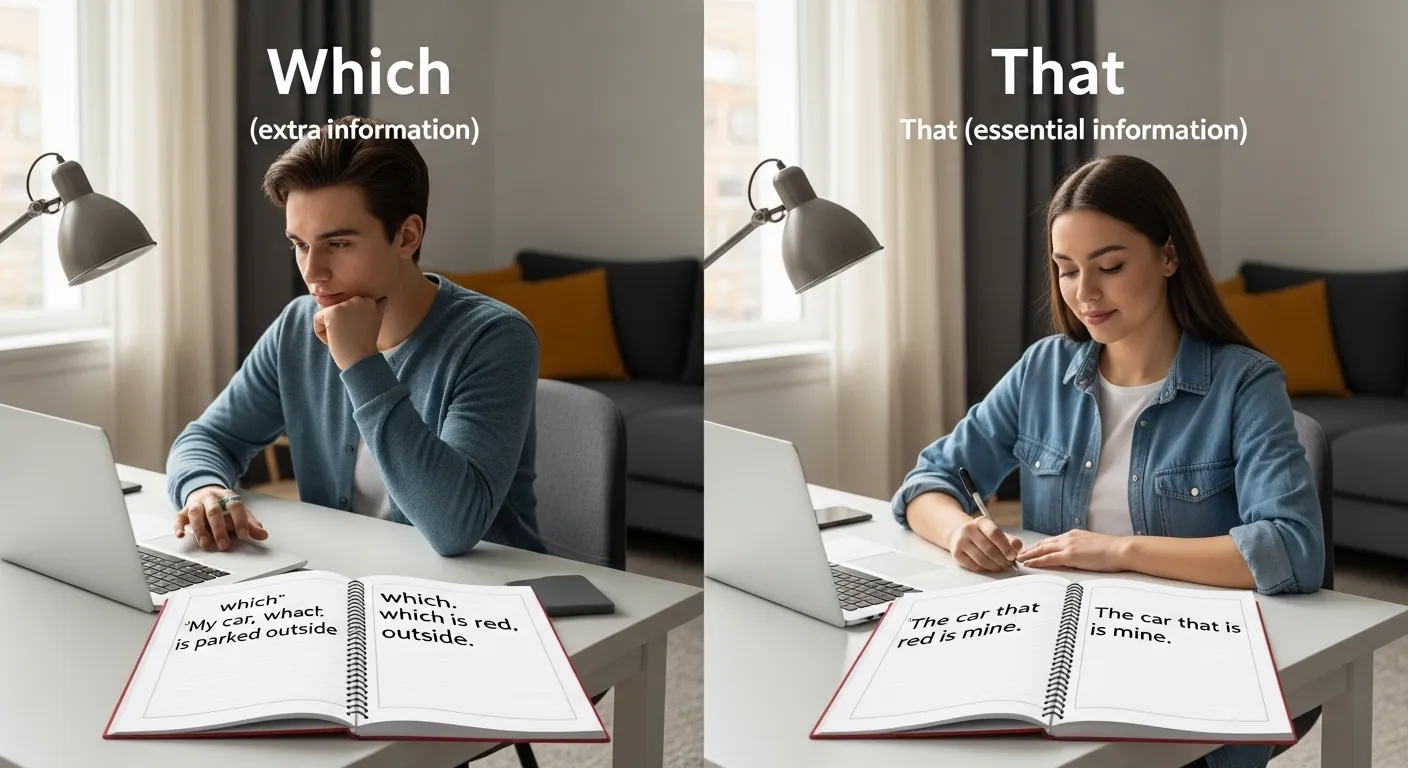
The confusion happens because both “which” and “that” introduce extra information about a noun. But the choice depends on whether the information is essential or extra.
Using the wrong word can change the meaning of your sentence or make your writing unclear.
This guide will explain the difference in a simple way. You will learn when to use each word, why the rule exists, and how to avoid mistakes.
By the end, you will use “which” and “that” with confidence in emails, essays, and daily writing.
Which or That – Quick Answer
Here is the simple rule:
- Use that for essential information.
- Use which for extra information.
Essential information means the sentence needs it to make sense. Extra information is helpful but not required.
Examples:
Using that (essential):
- The book that is on the table is mine.
(You need “that is on the table” to know which book.)
Using which (extra):
- The book, which is on the table, is mine.
(The extra detail is not required.)
Easy trick:
- No comma → use that
- Comma → use which
Example:
- Correct: The phone that I bought is new.
- Correct: The phone, which I bought yesterday, is new.
The Origin of Which or That
Both “which” and “that” are very old English words. They come from Old English, used over 1,000 years ago.
- “That” comes from Old English “þæt”
- “Which” comes from Old English “hwilc”
In early English, people used both words freely. There was no strict rule.
Over time, grammar experts created rules to improve clarity. Style guides like the Chicago Manual of Style and the Oxford Style Manual suggested using:
- “That” for essential clauses
- “Which” for extra clauses
This helped readers understand sentences faster.
Today, this rule is standard in formal writing, education, and professional communication.
British English vs American English Spelling
This topic is not about spelling. Both British and American English spell “which” and “that” the same way.
The difference is about usage preference.
- American English prefers “that” for essential clauses.
- British English often uses “which” more freely.
In the United States, formal writing strongly follows the “that” rule.
In the United Kingdom, both forms are accepted more often.
Comparison Table: British vs American Usage
| Type | American English | British English |
| Essential clause | That preferred | That preferred |
| Extra clause | Which preferred | Which preferred |
| Informal writing | Strict rule common | More flexible |
| Formal writing | Very strict | Slightly flexible |
| Comma usage | Important rule | Important rule |
Examples:
American style:
- The car that he bought is fast.
British style:
- The car which he bought is fast. (also acceptable)
Both are correct, but American English prefers “that.”
Which Spelling Should You Use?
Your audience matters.
Use that if:
- Your audience is in the United States
- You write academic papers
- You write professional content
- You want clear meaning
Use which if:
- The information is extra
- You use commas
- Your audience is global
- You write informally
Use either carefully if your audience is in:
- Canada
- Australia
- International readers
Best advice: Follow the comma rule. It always works.
Read More.Cold or COVID – How to Tell the Difference Quickly
Common Mistakes with Which or That
Here are frequent mistakes and fixes.
Mistake 1: Using “which” without commas
Wrong:
- The car which is blue is mine.
Correct:
- The car that is blue is mine.
OR
- The car, which is blue, is mine.
Mistake 2: Using “that” with commas
Wrong:
- The car, that is blue, is mine.
Correct:
- The car, which is blue, is mine.
Mistake 3: Using “which” for essential meaning
Wrong:
- The phone which I lost is expensive.
Correct:
- The phone that I lost is expensive.
Mistake 4: Ignoring meaning change
Example:
- The students that studied passed.
(Some students studied) - The students, which studied, passed.
(This sounds wrong and unclear)
Correct:
- The students who studied passed.
Mistake 5: Mixing rules in formal writing
Wrong:
- The product which we sell is popular.
Better:
- The product that we sell is popular.
Which or That in Everyday Examples
Here are real-life examples.
Email example
Correct:
- The file that you sent is correct.
Extra info example:
- The file, which you sent yesterday, is correct.
News example
Correct:
- The company that launched the app gained users.
Extra info:
- The company, which launched the app last year, gained users.
Social media example
Correct:
- I love the phone that I bought.
Extra info:
- I love my phone, which has great battery life.
Formal writing example
Correct:
- The study that was published shows results.
Extra info:
- The study, which was published in 2024, shows results.
Workplace example
Correct:
- The employee that finished early left.
Extra info:
- The employee, which finished early, left. (not correct for people)
Better:
- The employee who finished early left.
Which or That – Google Trends & Usage Data
Search data from Google Trends shows that many people search for “which or that.”
This happens because:
- Students learn grammar rules
- Writers want correct sentences
- Bloggers want professional content
- English learners want clarity
Popularity by country:
High search volume:
- United States
- United Kingdom
- Canada
- Australia
Common contexts:
- Academic writing
- Blog writing
- Emails
- Exams
- Professional communication
Usage trend shows people want simple grammar rules.
Comparison Table: Which vs That
| Feature | That | Which |
| Purpose | Essential info | Extra info |
| Comma | No comma | Uses comma |
| Importance | Required | Optional |
| Formal writing | Preferred | Used carefully |
| American English | Strongly preferred | Used for extra info |
| British English | Preferred | More flexible |
| Meaning impact | Changes meaning | Adds extra detail |
FAQs About Which or That
1. What is the main difference between which and that?
“That” adds essential information. “Which” adds extra information. Use commas with “which,” not with “that.”
2. Can which replace that?
Sometimes yes, but not in formal American English. “That” is safer for essential clauses.
3. Is it wrong to use which instead of that?
Not always. British English allows it more. But American English prefers “that.”
4. Do commas matter?
Yes. Commas show extra information. Use “which” with commas.
Example:
- Correct: The car, which is red, is fast.
5. Which is better for formal writing?
“That” is better for essential information. It is clearer and preferred.
6. Can I use that for extra information?
No. Use “which” for extra information.
Wrong:
- The phone, that I bought, is new.
Correct:
- The phone, which I bought, is new.
7. How can I remember the rule easily?
Simple trick:
- No comma → that
- Comma → which
Conclusion
Understanding “which or that” improves your writing clarity and professionalism. The rule is simple when you focus on meaning. Use “that” when the information is essential.
Use “which” when the information is extra and separated by commas.
This difference helps readers understand your message quickly. It also prevents confusion and improves sentence flow.
While British English allows more flexibility, American English strongly prefers using “that” for essential clauses. Following this rule is the safest choice, especially in academic and professional writing.
Always check if your sentence needs the information to make sense. If yes, use “that.” If not, use “which.” The comma is your best guide. With practice, this choice will become natural and easy.
Mastering this rule helps you write better emails, articles, and reports. Clear grammar builds trust and makes your writing more effective worldwide.

Andrew Michael Hurley is known for dark and atmospheric fiction. His stories often explore faith, fear, and isolation.