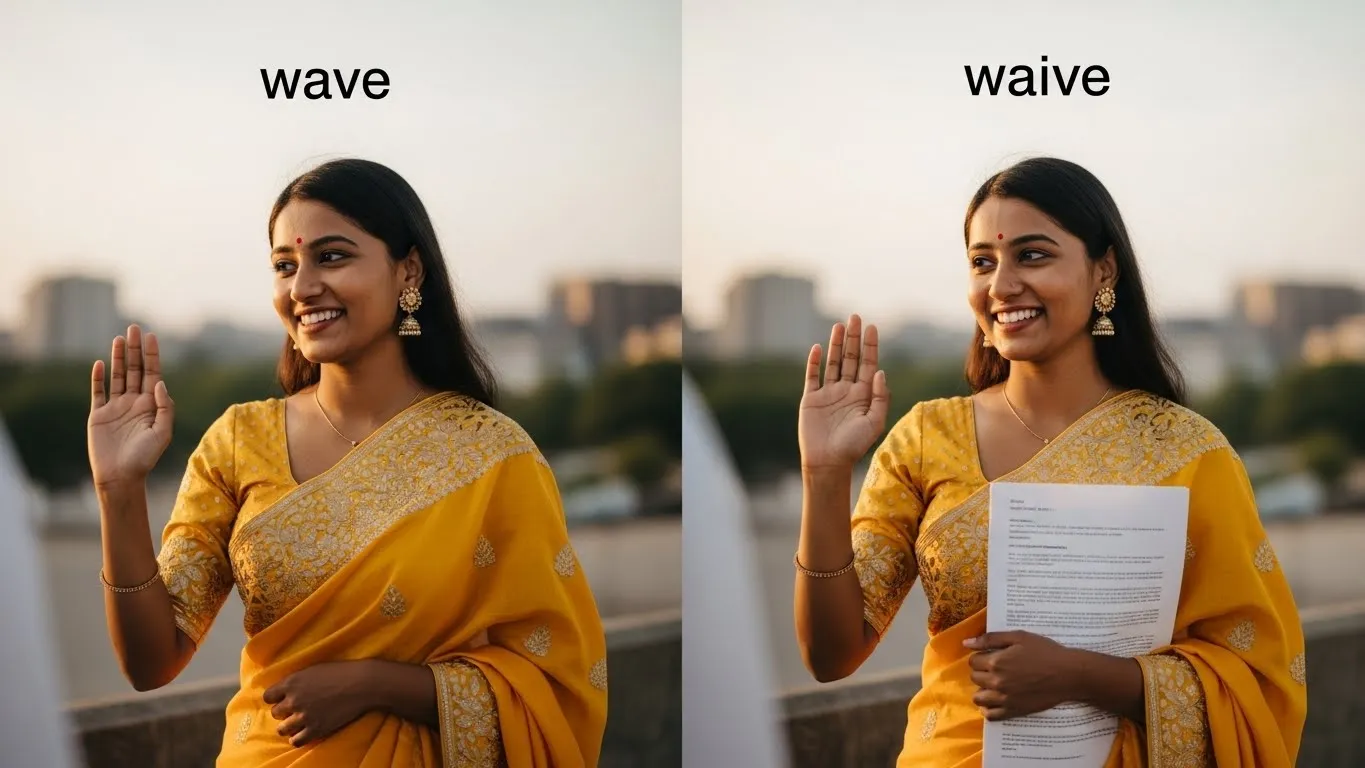
Many people confuse “waive” and “wave” because they sound the same. But using the wrong word can change the meaning of your sentence completely. Whether in emails, contracts, or casual writing, knowing the difference is important.
“Waive” means to give up a right, claim, or privilege, while “wave” refers to moving your hand to greet or signal or an undulating motion, like in water. People often search for this distinction to avoid mistakes in formal writing,
social media posts, or business communication. This guide will help you understand the difference, origin, correct usage, and common mistakes with clear examples.
Waive or Wave – Quick Answer
- Waive → To relinquish a right or claim.
Example: She decided to waive her right to a jury trial. - Wave → To move your hand to greet or motion of water or objects.
Example: He waved at his friend from across the street.
The Origin of Waive and Wave
- Waive comes from the Old French word waiver, meaning to abandon or relinquish.
- Wave comes from the Old English wafian, meaning to move back and forth.
Though they sound the same, their meanings have always been distinct. Confusion arises due to homophones—words that sound alike but have different meanings and spellings.
British English vs American English Spelling
Both waive and wave are spelled the same in British and American English. The difference is not in spelling but in context and usage.
| Word | Meaning (UK) | Meaning (US) | Example (UK) | Example (US) |
| Waive | Give up a right/claim | Give up a right/claim | They waived the fee for students. | She waived her right to appeal. |
| Wave | Move hand; water motion | Move hand; water motion | He waved goodbye at the station. | The flag waved in the wind. |
✅ Key takeaway: The spelling remains consistent; context determines meaning.
Which Spelling Should You Use?
- US audience → Use the standard waive and wave as explained.
- UK/Commonwealth → The same rules apply; no spelling change is needed.
- Global writing → Focus on meaning, not region; using the wrong word can confuse readers.
- Read More.Trek or Treck: Which Spelling Is Correct and Why It Matters
Common Mistakes with Waive or Wave
- Incorrect: I will wave my right to a refund.
Correct: I will waive my right to a refund. - Incorrect: She waived at her friend.
Correct: She waved at her friend. - Confusing homophones in professional writing can make emails or contracts unclear. Always double-check meaning.
Waive or Wave in Everyday Examples
- Emails: “We can waive the late fee for this month.”
- Social Media: “He waved at the camera in the video.”
- News: “The government decided to waive visa requirements.”
- Formal Writing: “The applicant waived the right to confidentiality.”
Waive or Wave – Google Trends & Usage Data
According to Google Trends:
- Wave is more commonly searched in general contexts like greetings, physics, and sports.
- Waive spikes in searches around legal, financial, and official matters.
Top countries searching for “waive”: USA, UK, Canada, Australia
Top countries searching for “wave”: USA, UK, India, Australia
Comparison Table – Waive vs Wave
| Word | Part of Speech | Meaning | Example |
| Waive | Verb | Give up a right/claim | She waived the fee. |
| Wave | Verb/Noun | Move hand or a motion; gesture | He waved at his neighbor. |
FAQs
1. Can you use waive and wave interchangeably?
No. They have completely different meanings despite sounding the same.
2. Which one is formal?
Waive is formal, mostly used in legal, financial, or official contexts.
3. Is wave only a verb?
No, it can be a noun too: “A wave of excitement swept the crowd.”
4. Are there any spelling differences between UK and US English?
No, both words are spelled the same in British and American English.
5. How do I remember the difference?
Think “waive” = give up, “wave” = hand motion. Context is key.
6. Can I waive a hand gesture?
No. Waive is only for rights, claims, or privileges.
7. Are there related words to help me?
Yes: waiver (noun), waving (gerund form of wave).
Conclusion
Understanding waive and wave is simple once you know the meaning. Waive is about giving up rights, while wave is about motion or gestures. Both words are spelled the same in British and American English,
so context is the main factor. Avoid common mistakes by checking the meaning before writing.
For professional communication, legal documents, or casual emails, using the correct word ensures clarity. Globally, readers may get confused by the homophone, so taking a second to verify can save misunderstandings. Remember: waive = rights, wave = motion. With this knowledge, you can confidently write, speak, and edit without errors.

David Szalay a British writer who focuses on modern life and relationships. His stories are simple but deep.