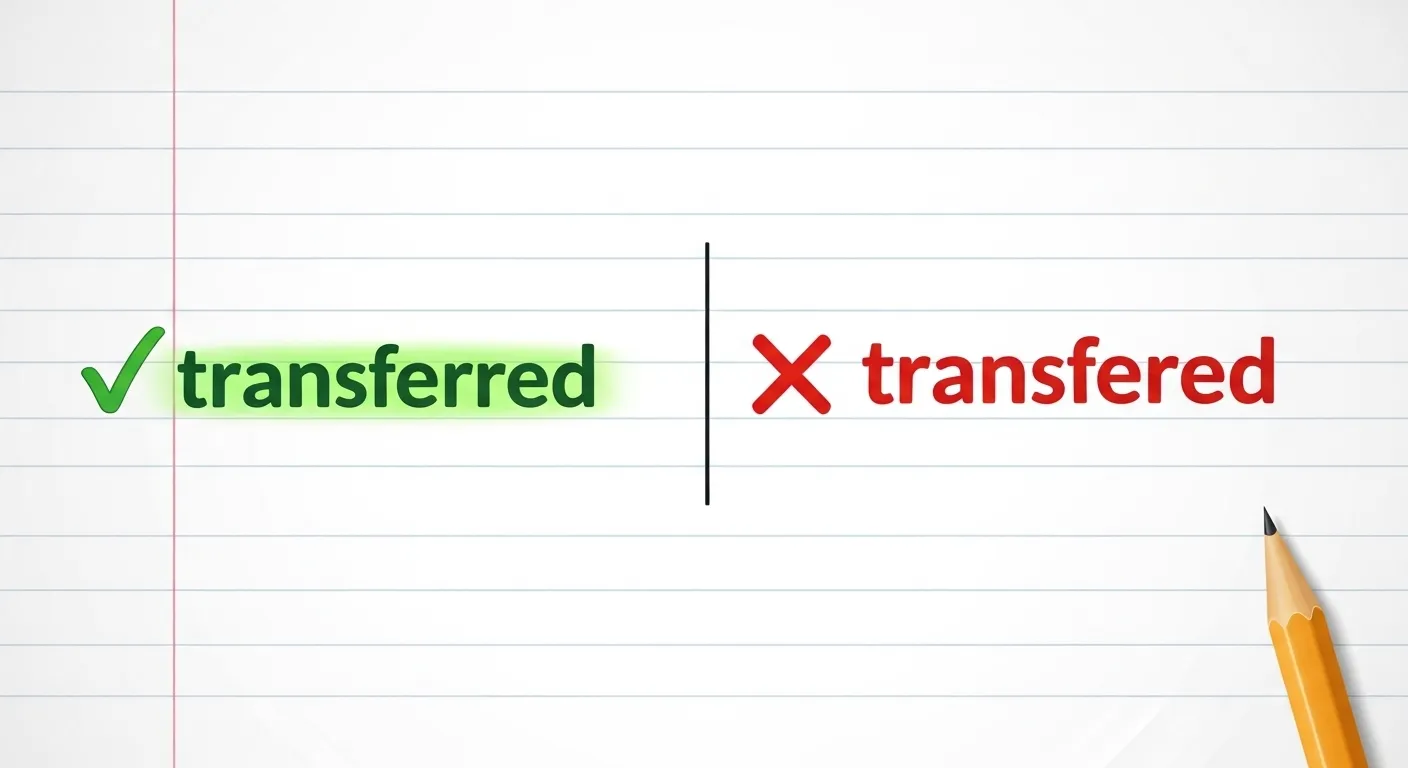
Transferred is correct the double “r” is needed when adding -ed to “transfer.”
Many people get confused when it comes to spelling the past tense of “transfer”. Should it be transferred or transfered? While it may seem like a minor detail, spelling mistakes can make emails, reports, and social media posts look unprofessional.
Knowing the correct form is especially important for students, writers, professionals, and anyone using English in daily communication.
The confusion often arises because English has irregular spelling rules when doubling consonants.
Add to this the differences between British and American English, and it’s easy to see why searches for “transferred or transfered” are common.
In this article, we will clarify the correct spelling, explore the origin of the word, compare UK and US conventions, show practical examples, and provide advice for consistent usage.
By the end, you’ll be confident about which spelling to use in your writing.
Transferred or Transfered – Quick Answer
The correct spelling is transferred with a double r.
- ✅ Correct: She transferred to a new school last week.
- ❌ Incorrect: She transfered to a new school last week.
Rule: When a one-syllable or multi-syllable word ends in a single vowel + single consonant, double the consonant before adding -ed if the stress is on the last syllable. In transfer, the stress is on the second syllable: tran-FER, so we double the r → transferred.
Examples:
- I have transferred the files to your email.
- He transferred his loyalty to another team.
- They transferred the funds safely.
The Origin of Transferred
The word transfer comes from Latin: trans- (across) + ferre (to carry). It has been used in English since the 15th century, primarily in formal, legal, and administrative contexts.
The spelling with a double r in the past tense follows traditional English rules for doubling consonants in verbs with stress on the final syllable. This pattern is consistent with words like prefer → preferred and refer → referred.
Historically, English has adopted and adapted Latin words, and spelling rules evolved to maintain pronunciation clarity. Misconceptions like transfered likely come from oversimplifying or analogizing with verbs like help → helped, which do not double the consonant.
Read More Engrained or Ingrained: Which One is Correct?
British English vs American English Spelling
British and American English sometimes differ in spelling, especially with doubled consonants.
| Feature | British English | American English | Example |
| Doubling final consonants | Double the consonant if stress is on last syllable | Same rule, but less strict in some cases | transfer → transferred |
| Common mistake | transfered | transfered | ❌ |
| Correct form | transferred | transferred | ✅ |
Rule Summary: Both UK and US English use transferred. The double r is correct in both. Some other verbs (e.g., travel → travelled) may differ: UK doubles, US often doesn’t (traveled).
Which Spelling Should You Use?
- US audience: Use transferred. It is universally recognized in American English.
- UK/Commonwealth audience: Also use transferred. Consistency is key, especially in formal documents.
- Global writing: Stick with transferred to avoid confusion. This spelling is universally correct and professional.
💡 Tip: Avoid transfered in any formal writing; it is considered a spelling mistake worldwide.
Common Mistakes with Transferred
Here are some frequent errors people make with transferred:
- Transfered → Transferred
❌ Incorrect: I transfered the money yesterday.
✅ Correct: I transferred the money yesterday. - Transferrred → Transferred (triple r)
❌ Incorrect: He transferrred the call.
✅ Correct: He transferred the call. - Mispronouncing → misspelling
Even when pronounced correctly, people sometimes type transfered. - Confusing with “transfering”
Present participle: transferring (double r) is correct; avoid transfering. - Mixing with other verbs
Words like enter → entered don’t double the consonant. This can cause mistakes with transfer.
Transferred in Everyday Examples
Here’s how transferred appears in daily contexts:
Emails:
- Your request has been transferred to the accounts department.
News articles:
- The player was transferred to a rival club during the summer window.
Social media:
- I transferred my photos to Google Drive so convenient!
Formal writing:
- The legal title was transferred in accordance with the contract.
Using the correct spelling ensures clarity and professionalism in all contexts.
Transferred – Google Trends & Usage Data
Search data indicates that users often type “transfered” by mistake, leading to high search volumes for “transferred or transfered”.
- Top countries searching: UK, US, Canada, Australia, India.
- Context: School transfers, bank transfers, file transfers, sports transfers.
- Trend observation: The correct spelling transferred is far more common in published articles, blogs, and official documents.
Keyword Variations Comparison Table
| Variation | Correct? | Notes |
| transferred | ✅ | Standard past tense form |
| transfered | ❌ | Common misspelling |
| transferrred | ❌ | Typo with triple r |
| transferring | ✅ | Present participle |
| transfering | ❌ | Incorrect present participle |
FAQs about Transferred
1. Is it “transfered” or “transferred”?
✅ Correct: transferred. Double r is required.
2. Why do we double the “r” in transferred?
Because the stress is on the second syllable: tran-FER → double consonant before -ed.
3. Is this spelling difference different in US and UK English?
No, both use transferred.
4. Can “transfered” ever be correct?
❌ No. It is considered a spelling mistake.
5. How do I remember the spelling?
Think of similar verbs: refer → referred, prefer → preferred.
6. What about “transferring”?
Double the r in the present participle as well: transferring, not transfering.
7. Does this apply to all words ending in -fer?
Yes, for stressed final syllable verbs: offer → offered (unstressed, no double) vs refer → referred (stressed, double).
Conclusion
The correct past tense of transfer is transferred, with a double r. Avoid the common mistake transfered, which is incorrect in both British and American English.
Understanding the stress-based spelling rule makes it easier to apply the correct form to similar verbs like refer → referred and prefer → preferred.
Whether writing emails, preparing school assignments, drafting reports, or posting on social media, using transferred ensures your writing is professional and error-free.
For global audiences, this spelling is universally accepted, so it’s best to stick with it. Knowing the difference between correct and incorrect forms improves clarity, prevents miscommunication, and enhances your credibility.
Always remember: transferred is correct, and consistency is key. By using this spelling rule, you’ll never worry about confusing your readers again.

Sarah Hall is an English novelist and short story writer. She often writes about nature, identity, and strong characters.