Many English learners, writers, and even native speakers often pause when they need to write tomorrows or tomorrow’s.
The confusion usually appears in emails, headlines, homework, or social media posts where a single apostrophe can completely change the meaning.
Is it talking about more than one tomorrow, or something that belongs to tomorrow? Because both forms look almost the same, people frequently use the wrong one without realizing it.
This keyword is commonly searched because it mixes two tricky grammar ideas: plural nouns and possessive nouns.
English apostrophes do not always mean the same thing, and that’s where mistakes happen. Writers want a quick answer, but they also want to understand why one form is correct and the other is not.
This article solves that confusion clearly and simply. You’ll get a fast explanation, real-life examples, common mistakes to avoid, and guidance on which form to use in different situations.
By the end, you’ll confidently know when to write tomorrow’s and when tomorrows is actually correct.
Tomorrows or Tomorrow’s – Quick Answer
Tomorrow’s is the possessive form.
It means something belonging to tomorrow.
Examples:
- Tomorrow’s meeting is canceled.
- I’m preparing for tomorrow’s exam.
Tomorrows is the plural form.
It means more than one tomorrow (rarely used).
Examples:
- We hope for better tomorrows.
- Scientists worry about our children’s tomorrows.
👉 Most of the time, you need “tomorrow’s.”
The Origin of Tomorrows or Tomorrow’s
The word tomorrow comes from Old English to morgenne, meaning “on the next day.” Over time, it became a standard noun referring to the day after today.
English later developed rules for:
- Plural nouns → add -s
- Possessive nouns → add ’s
That’s why:
- Tomorrow’s shows ownership or connection
- Tomorrows shows quantity (more than one tomorrow)
The confusion exists because both forms end with s, but the apostrophe changes the meaning completely.
British English vs American English Spelling
There is no spelling difference between British and American English for this keyword. Both follow the same grammar rules.
| Form | British English | American English | Meaning |
| tomorrow’s | ✔️ Correct | ✔️ Correct | Possessive |
| tomorrows | ✔️ Correct | ✔️ Correct | Plural (rare) |
✅ The difference is grammatical, not regional.
Which Spelling Should You Use?
Choose based on meaning, not location:
- US audience → Use tomorrow’s for events or plans
- UK/Commonwealth audience → Same rule applies
- Global or professional writing → Tomorrow’s is almost always correct
👉 If you are talking about a plan, event, news, or task, use tomorrow’s.
Read More Grampa or Grandpa: Which Spelling Is Correct?
Common Mistakes with Tomorrows or Tomorrow’s
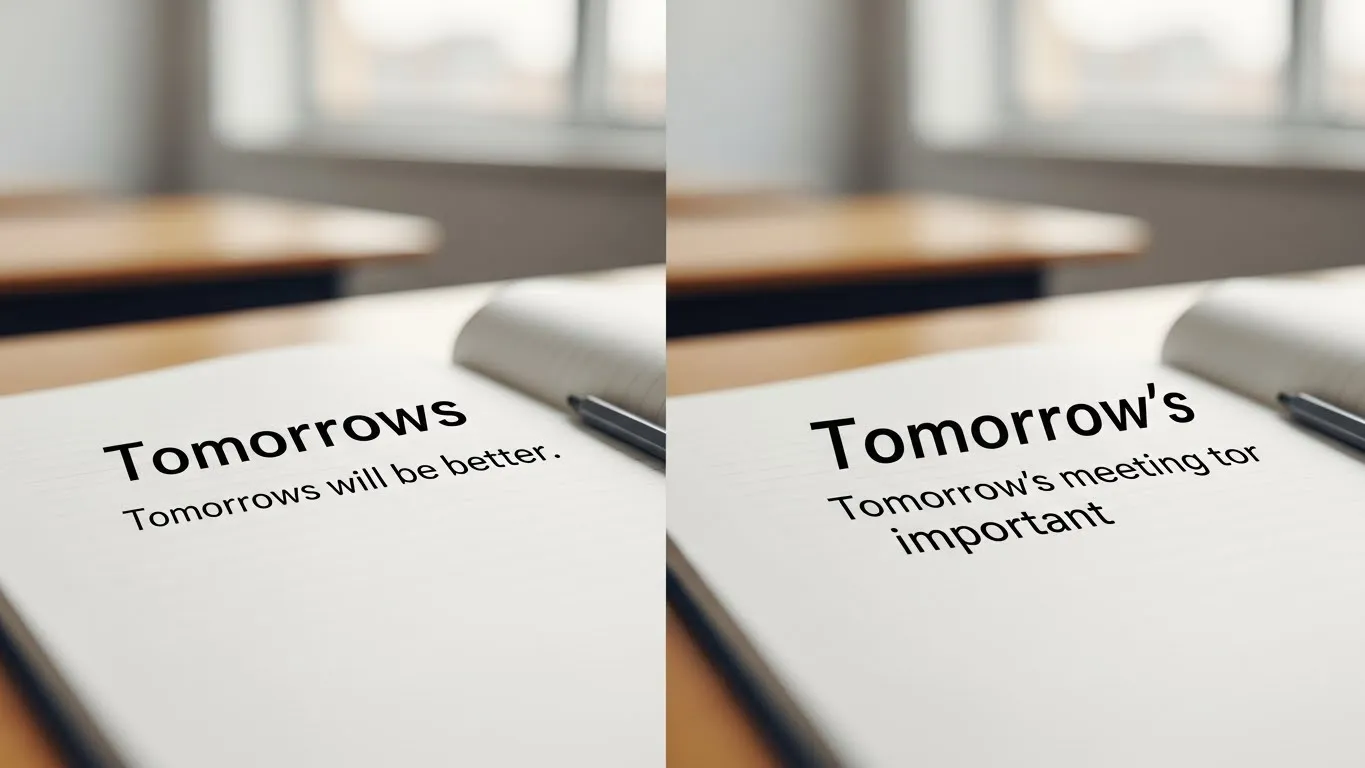
❌ Tomorrows meeting is important.
✅ Tomorrow’s meeting is important.
❌ I am ready for tomorrows exam.
✅ I am ready for tomorrow’s exam.
❌ Tomorrow’s will be better.
✅ Tomorrows will be better. (only if plural is intended)
Tomorrows or Tomorrow’s in Everyday Examples
Emails
- Please confirm tomorrow’s schedule.
News
- Tomorrow’s weather forecast predicts rain.
Social Media
- Can’t wait for tomorrow’s match! ⚽
Formal Writing
- Tomorrow’s results will influence future decisions.
Plural (rare but valid)
- We must protect future tomorrows.
Tomorrows or Tomorrow’s – Google Trends & Usage Data
Search trends show tomorrow’s is far more commonly used worldwide.
This is because people usually talk about:
- meetings
- events
- plans
- deadlines
Tomorrows appears mostly in:
- motivational quotes
- poetry
- philosophical writing
👉 Everyday usage strongly favors tomorrow’s.
Comparison Table: Tomorrows vs Tomorrow’s
| Form | Type | Meaning | Common Usage |
| tomorrow’s | Possessive | Belonging to tomorrow | Very common |
| tomorrows | Plural noun | More than one tomorrow | Rare |
FAQs: Tomorrows or Tomorrow’s
1. Is “tomorrow’s” always correct?
No, but it is correct in most everyday situations.
2. Can “tomorrows” be grammatically correct?
Yes, when talking about multiple future days.
3. Does American English prefer one form?
No, both dialects follow the same rule.
4. Is “tomorrow’s” a contraction?
No, it is a possessive noun, not a contraction.
5. Can I use “tomorrows” in formal writing?
Yes, but only when plural meaning is intended.
6. Why do people confuse these two?
Because apostrophes in English are often misunderstood.
7. Which should I use in SEO content?
Use tomorrow’s unless you clearly mean plural.
Conclusion
The difference between tomorrows and tomorrow’s is small in appearance but big in meaning.
Tomorrow’s is possessive and refers to something connected to the next day, such as a meeting, exam, event, or plan.
This is the form you will use most often in emails, articles, and professional writing. Tomorrows, on the other hand, is simply the plural of tomorrow and is used far less frequently, mainly in creative or philosophical contexts.
There is no British or American spelling difference here only a grammar rule. When in doubt, ask yourself a simple question: Does this belong to tomorrow? If yes, use tomorrow’s.
If you are talking about multiple future days, then tomorrows is correct.
Understanding this distinction improves clarity, professionalism, and confidence in your writing. A single apostrophe can change everything, but now you know exactly how to use it.

David Szalay a British writer who focuses on modern life and relationships. His stories are simple but deep.