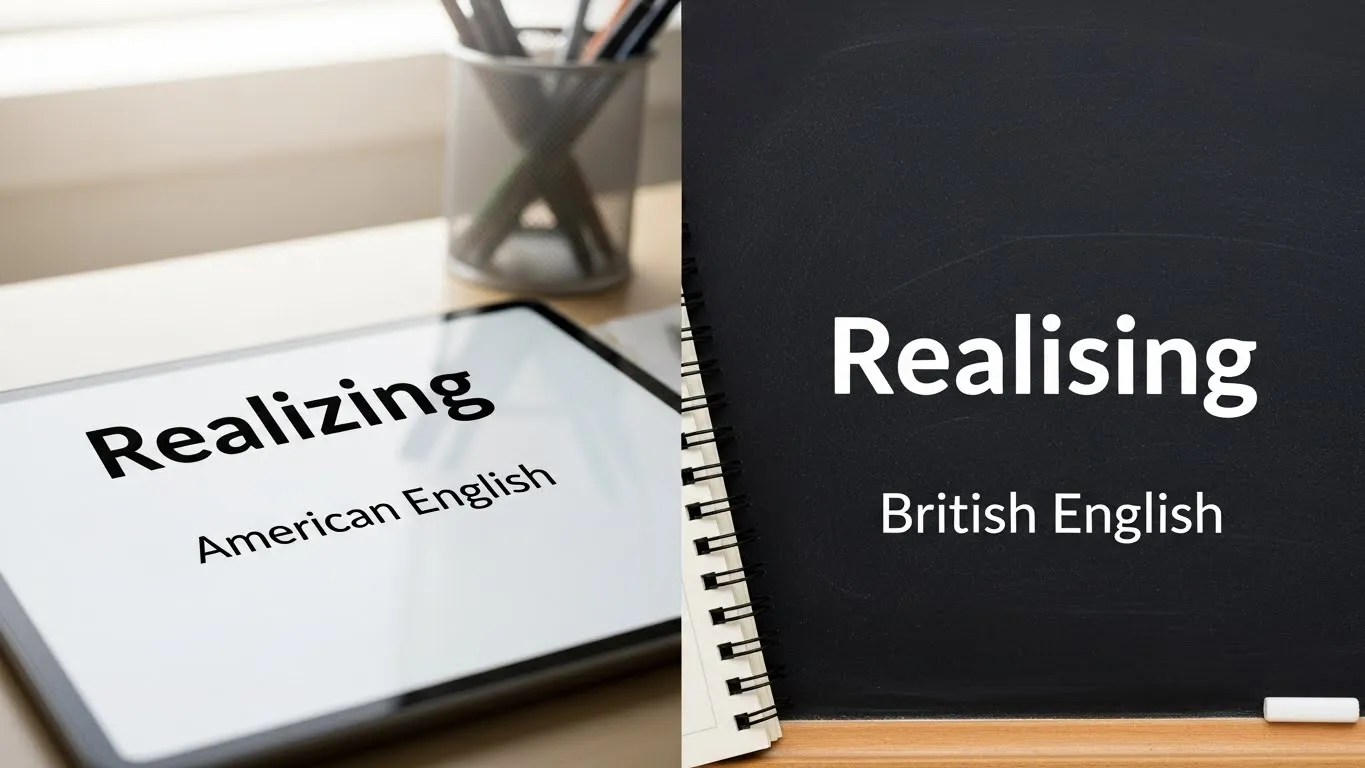
Have you ever paused while writing and wondered whether it’s realizing or realising? You’re not alone.
This is one of the most common spelling confusions in English, especially for students, bloggers, professionals, and non-native speakers.
Both spellings look correct, both appear in trusted sources, and both mean exactly the same thing so why do two versions exist?
People usually search for “realizing or realising” because they want to avoid mistakes in exams, professional emails, articles, or content.
Using the “wrong” spelling for your audience can make your writing look inconsistent or unpolished.
This confusion mainly comes from differences between American English and British English, which follow slightly different spelling rules.
This article solves that confusion quickly and clearly. You’ll get a simple answer, learn where the spellings come from, see real-world examples, and understand which version you should use based on your audience.
By the end, you’ll never hesitate again when choosing between realizing and realising.
Realizing or Realising – Quick Answer
Both are correct.
The difference is based on region, not meaning.
- Realizing → American English 🇺🇸
Example: I am realizing my mistakes now. - Realising → British English 🇬🇧
Example: She is realising the truth slowly.
They have the same meaning: becoming aware of something or understanding it clearly.
The Origin of Realizing / Realising
The verb realize comes from the French word réaliser, meaning to make real or to become aware. When English adopted the word, spelling rules evolved differently in different regions.
In the 18th and 19th centuries, British English often used “-ise” endings (realise, organise). Later, American English, influenced by lexicographer Noah Webster, simplified many spellings to “-ize” (realize, organize).
That’s why both spellings exist today. They share the same history, pronunciation, and meaning—only the spelling rule changed by region.
British English vs American English Spelling
| Aspect | American English | British English |
| Preferred spelling | Realizing | Realising |
| Ending used | -ize | -ise |
| Used in | USA | UK, Australia, New Zealand |
| Meaning | Same | Same |
| Pronunciation | Same | Same |
💡 Important: British English also accepts -ize in some cases, but -ise is more common in everyday use.
Which Spelling Should You Use?
Choose based on your audience:
- US audience → Use realizing
- UK & Commonwealth (UK, Australia, Canada) → Use realising
- Global or mixed audience → Pick one style and stay consistent
- Academic or professional writing → Follow your style guide (APA, Oxford, etc.)
Consistency matters more than the spelling itself.
Read More Qatar or Emirates: Which Airline Is Better for International Travel?
Common Mistakes with Realizing / Realising
❌ Mixing both spellings in one document
✔ Choose one and stick to it
❌ Thinking one spelling is “wrong”
✔ Both are correct
❌ Changing spelling without changing audience
✔ Match spelling to reader location
❌ Assuming pronunciation is different
✔ Pronunciation is the same
Realizing / Realising in Everyday Examples
Emails
- I am realizing the issue after reviewing the report.
- I am realising the issue after reviewing the report.
News
- The company is realizing the impact of inflation.
- The government is realising the policy risks.
Social Media
- Just realizing how fast time flies!
- Just realising how important this is.
Formal Writing
- The study focuses on realizing long-term goals.
- The report discusses realising economic potential.
Realizing or Realising – Google Trends & Usage Data
Search data shows clear regional patterns:
- Realizing is most popular in the United States
- Realising dominates searches in the UK, Australia, and New Zealand
- Both terms have steady global usage
- Meaning and context are identical across regions
This confirms that the choice is regional, not grammatical.
Comparison Table: Realizing vs Realising
| Feature | Realizing | Realising |
| Correct spelling | ✅ Yes | ✅ Yes |
| American English | ✅ Preferred | ❌ Rare |
| British English | ⚠ Accepted | ✅ Preferred |
| Meaning | Same | Same |
| SEO usage | US-focused | UK-focused |
FAQs: Realizing or Realising
1. Is realizing American English?
Yes, it is the standard American spelling.
2. Is realising British English?
Yes, it is commonly used in British English.
3. Do realizing and realising mean the same thing?
Yes, they have identical meanings.
4. Which spelling is correct for exams?
Use the spelling taught in your curriculum.
5. Can I use both in one article?
No, consistency is important.
6. Is “realise” ever used in American English?
Rarely, and usually in British-style writing.
7. Which spelling is better for SEO?
Use realizing for US SEO and realising for UK SEO.
Conclusion
The debate between realizing or realising is not about right or wrong it’s about where and who you are writing for.
Both spellings are correct, both come from the same origin, and both mean becoming aware or understanding something clearly. The only real difference lies in regional spelling conventions.
If your audience is in the United States, realizing is the best choice. If you’re writing for the UK or Commonwealth countries, realising will feel more natural.
For global content, consistency is key pick one version and use it throughout your writing.
Understanding this difference helps you write more confidently, avoid unnecessary corrections, and present polished, professional content.
Once you know the rule, the choice becomes easy and you’ll never second-guess it again.

Claire Keegan an Irish author famous for powerful short stories. She writes in a clear and emotional style.