Have you ever seen a large black bird flying across the sky and wondered, “Is that a raven or crow?” Many people search for “raven or crow” because these two birds look similar at first glance, yet they have notable differences in size, sound, behavior, and symbolism.
Misidentifying them can lead to confusion, whether you’re birdwatching, reading literature, or interpreting cultural references.
Understanding the distinction is useful for students, nature enthusiasts, writers, and even social media users who want to post accurate content.
This guide clears the confusion, explains the origin of the words, highlights common mistakes, and gives practical tips for identifying each bird.
By the end, you’ll be confident spotting a raven from a crow and using the terms correctly in everyday language.
Raven or Crow – Quick Answer
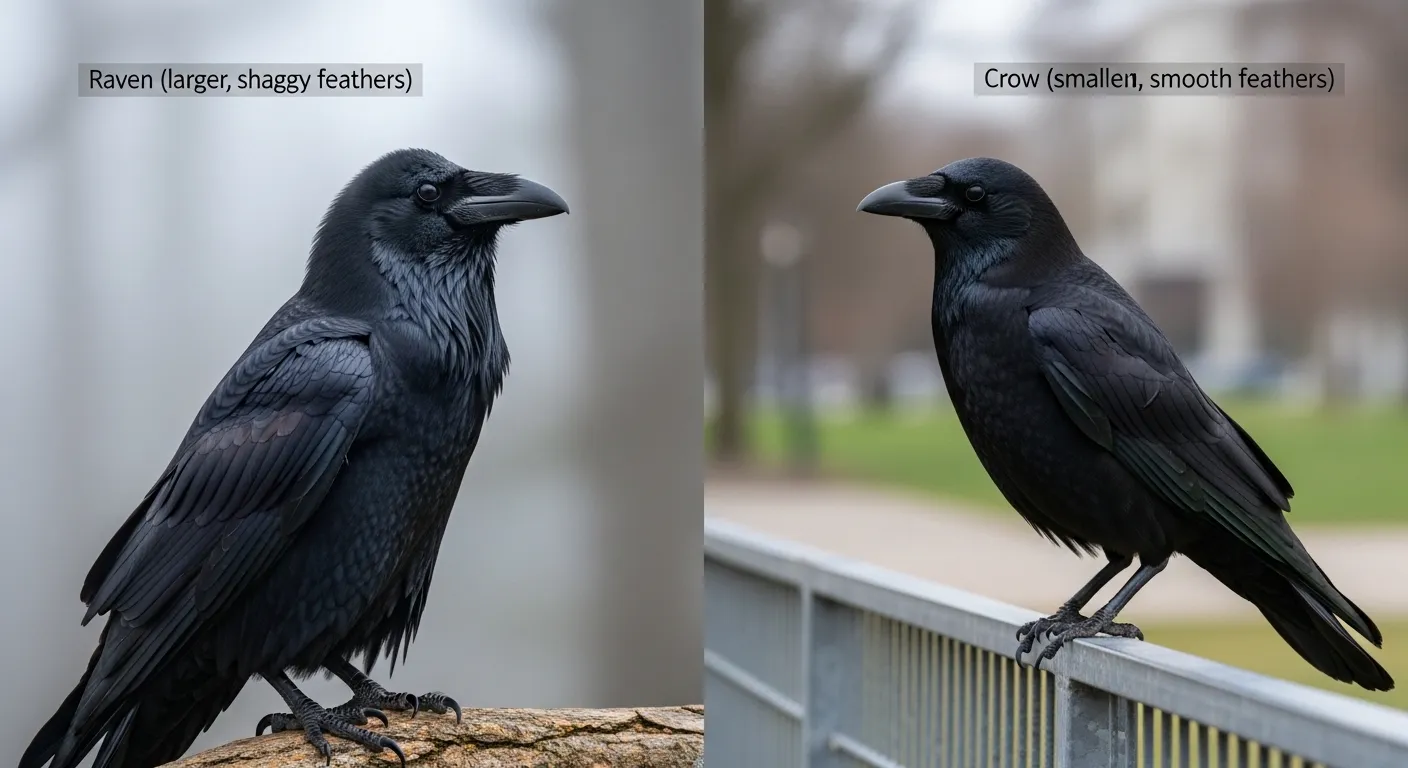
Ravens and crows are both black birds belonging to the corvid family. While they share many similarities, here are the main differences:
| Feature | Raven | Crow |
| Size | Larger (24–27 inches) | Smaller (17–21 inches) |
| Tail Shape | Wedge-shaped | Fan-shaped |
| Sound | Deep, croaking “gronk” | Higher, cawing “caw” |
| Beak | Thick and curved | Slim and straight |
| Flight Pattern | Soaring, gliding | Flapping, direct flight |
| Social Behavior | Often alone or in pairs | Flocks in large groups |
Example in sentence:
- Raven: “A raven perched on the cliff, its wings spread wide in the wind.”
- Crow: “A crow cawed loudly as it flew over the park.”
The Origin of Raven or Crow
The words raven and crow have rich linguistic histories.
- Raven comes from Old English hræfn, tracing back to Proto-Germanic hrabnaz. The term often appears in mythology and literature, symbolizing mystery or intelligence.
- Crow originates from Old English crāwe, linked to Proto-Germanic krāwō. Crows were commonly mentioned in folklore, often representing adaptability and community.
The confusion is understandable because both words have been used interchangeably in some historical texts. Over time, however, naturalists and writers distinguished them by size, sound, and cultural symbolism.
British English vs American English Spelling
Interestingly, raven and crow are spelled the same in both British and American English. Unlike words such as colour vs color, there is no regional spelling difference here.
| Word | British English | American English | Notes |
| Raven | raven | raven | Same spelling |
| Crow | crow | crow | Same spelling |
The main difference lies in usage and idioms. For example:
- UK: “As the crow flies” (common in literature and maps).
- US: Same idiom widely used, but may appear more in navigation contexts.
Which Spelling Should You Use?
Since raven and crow have consistent spelling in all English variants, focus on context instead:
- US Audience: Use standard spellings; no changes required.
- UK/Commonwealth: Standard spellings also apply. Idioms may differ.
- Global Audience: Always stick with raven and crow to ensure universal understanding.
The key is accuracy in describing the bird or using the metaphor correctly rather than worrying about spelling.
Read More Trick or Trade: Understanding the Correct Usage and Spelling
Common Mistakes with Raven or Crow
Many people make these frequent errors:
- Mixing the two birds: Mistaking a crow for a raven because both are black.
Correction: Look at size, tail shape, and call. - Using idioms incorrectly: “Eat like a raven” vs “Eat like a crow” – idioms differ by culture.
Correction: Verify context in literature or sayings. - Plural forms: People write ravenses or crowses.
Correction: Correct plural: ravens, crows. - Pronunciation errors: Raven often mispronounced as /ˈrɑːvən/ instead of /ˈreɪvən/.
- Symbolism confusion: Assuming all black birds symbolize bad luck.
Correction: Ravens often symbolize intelligence, crows symbolize adaptability.
Raven or Crow in Everyday Examples
Using these words correctly enhances writing, email, and social media posts:
- Email: “I saw a raven outside the window; it reminded me of the literature class discussion.”
- News: “A murder of crows gathered near the city park, alarming residents.”
- Social Media: “Caught a raven flying over the mountains—amazing sight!”
- Formal Writing: “The raven’s intelligence has been studied extensively in ornithology research.”
- Literature: “Edgar Allan Poe’s The Raven symbolizes the permanence of grief.”
Practical usage helps you avoid generic statements like “big black bird,” which can confuse readers.
Raven or Crow – Google Trends & Usage Data
Based on Google Trends data:
- Searches for “raven” spike during Halloween and literature studies.
- Searches for “crow” peak in spring and summer, often related to nature photography.
- Popularity is highest in the US, UK, Canada, and Australia.
| Keyword | Avg Monthly Searches | Peak Season | Main Interest Region |
| Raven | 22,000 | October | US, UK |
| Crow | 18,500 | April – June | US, Canada |
Insight: People search when identifying birds, discussing literature, or exploring folklore.
Keyword Variations Comparison Table
| Variation | Usage Example | Notes |
| Raven | “The raven perched on the branch.” | Formal or literary contexts |
| Crows | “Crows flew over the village.” | Plural form, common usage |
| Black raven | “A black raven cawed loudly.” | Emphasizes color |
| Common crow | “Common crows are everywhere.” | Identifies species broadly |
| Bird – Raven | “Bird – Raven” in encyclopedia entries | Taxonomy and educational use |
FAQs About Raven or Crow
1. How can I tell a raven from a crow?
Look at size, tail shape, beak, and call. Ravens are bigger with wedge-shaped tails; crows have fan-shaped tails.
2. Are ravens and crows related?
Yes, both belong to the corvid family and share intelligence and problem-solving skills.
3. Do ravens and crows have different sounds?
Yes, ravens have a deep croaking sound; crows have a high-pitched “caw.”
4. Can I use “crow” and “raven” interchangeably?
Only loosely; in literature, myth, or science, they are distinct.
5. Why do people confuse ravens and crows?
Both are black, intelligent birds; size and vocal differences are subtle from afar.
6. Is there a cultural difference between ravens and crows?
Yes, ravens often symbolize wisdom or mystery; crows symbolize adaptability and community.
7. Do ravens live alone?
Often alone or in pairs. Crows usually gather in large flocks.
Conclusion
Understanding the difference between raven or crow is more than just bird identification it’s about clear communication, accurate writing, and cultural literacy.
Ravens are larger, solitary, and often associated with mystery or intelligence, while crows are smaller, social, and adaptable. Using the correct term in emails, social media, news, and literature ensures your message is precise.
Remember, the spelling remains the same in British and American English, so focus on context and meaning.
By noticing size, tail shape, flight pattern, and sound, you can confidently distinguish these black birds in nature or writing.
if you’re a student, writer, or casual observer, knowing the difference enhances your understanding of nature and language, helping you use these terms correctly every time.

Jon McGregor a British writer known for quiet, realistic stories. His writing focuses on everyday life and human emotions.