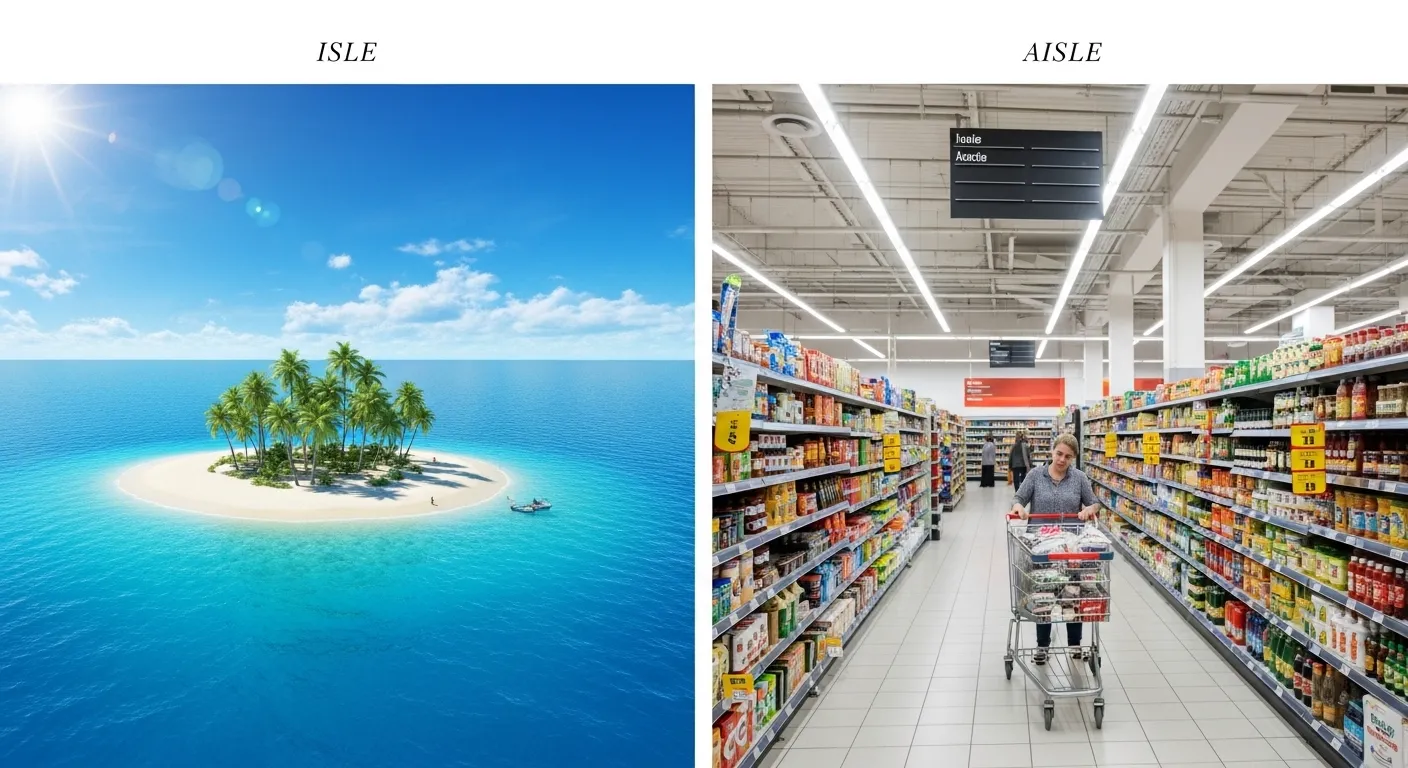
Many people get confused between “isle” and “aisle” because they sound exactly the same. While they may seem interchangeable, these words have very different meanings and uses.
Confusing them can lead to embarrassing mistakes in emails, social media posts, essays, and professional writing.
People often search “isle or aisle” when writing about travel, weddings, shopping, or locations because these contexts frequently involve either a small island or a passageway.
Understanding the difference helps avoid mistakes and ensures your writing is clear and professional.
This guide will provide a quick answer, show the origin of these words, compare British vs American English, give usage advice, highlight common mistakes, and provide examples you can use in everyday writing.
By the end, you’ll know exactly which word to use and when.
Isle or Aisle – Quick Answer
- Isle → A small island. Example: “We stayed on a peaceful isle in the Caribbean.”
- Aisle → A passage between rows (in a church, plane, supermarket, etc.). Example: “She walked down the wedding aisle with grace.”
Tip: If you are talking about land surrounded by water → isle. If you are talking about a walkway → aisle.
The Origin of Isle or Aisle
- Isle comes from the Old French word “isle”, which in turn comes from Latin “insula”, meaning island. It has been used in English since the 13th century to describe small islands.
- Aisle comes from the Old French word “ale” (from Latin “ala”, meaning wing). It originally described a passage alongside the nave of a church. Over time, the meaning expanded to include any narrow passage between rows of seats or shelves.
Both words sound identical in modern English, but their spellings reflect their different histories and meanings.
British English vs American English Spelling
Both isle and aisle are spelled the same in British and American English, but usage context may vary slightly.
| Word | British English Usage | American English Usage | Example |
| Isle | Small islands, often poetic | Same | “The Isle of Wight is beautiful.” |
| Aisle | Passage in church, theater, or store | Same | “Please stay in the supermarket aisle.” |
Note: Pronunciation remains the same in both versions. The confusion is mainly in spelling, not speech.
Which Spelling Should You Use?
- If you are writing for a US audience: Use aisle for passages, isle for islands.
- If you are writing for a UK or Commonwealth audience: Same rule applies.
- Global content (blogs, social media, travel guides): Stick to standard meanings: isle = island, aisle = walkway.
Using the correct word enhances clarity and professionalism in all forms of writing.
Read More Alum or Alumni: Understand the Correct Usage Clearly
Common Mistakes with Isle or Aisle
- Using isle for a supermarket passage:
❌ “I walked down the bread isle.”
✅ “I walked down the bread aisle.” - Using aisle for an island:
❌ “We explored the hidden aisle in the lake.”
✅ “We explored the hidden isle in the lake.” - Mixing both in formal writing: Avoid spelling mistakes in emails, essays, and articles, as they look unprofessional.
- Autocorrect errors: Some devices may auto-correct “aisle” to “isle” or vice versa. Always double-check.
Isle or Aisle in Everyday Examples
Emails:
- ❌ “The conference room isle is blocked.”
- ✅ “The conference room aisle is blocked.”
News Articles:
- ✅ “A new luxury resort opened on a remote isle in the Mediterranean.”
Social Media:
- ✅ “She looked stunning walking down the wedding aisle.”
Formal Writing:
- ✅ “The historic isle has been preserved for centuries.”
- ✅ “Ensure the emergency aisle is clear at all times.”
Isle or Aisle – Google Trends & Usage Data
Search trends show high interest in “isle or aisle” around wedding seasons, travel planning, and grocery shopping times.
| Keyword | Peak Interest | Countries |
| Isle | Summer months (travel) | UK, US, Australia |
| Aisle | Wedding season, Christmas shopping | US, UK, Canada |
People search to clarify spelling before writing, reflecting confusion caused by pronunciation similarity.
Comparison Table – Isle vs Aisle
| Feature | Isle | Aisle |
| Meaning | Small island | Passageway between rows |
| Pronunciation | /aɪl/ | /aɪl/ |
| Origin | Old French → Latin | Old French → Latin |
| Common Context | Travel, geography, poetry | Weddings, supermarkets, churches, planes |
| British & American Spelling | Same | Same |
| Common Mistake | Used for passageways | Used for islands |
FAQs – Isle or Aisle
- Q: Can “aisle” ever mean island?
A: No, “aisle” only refers to a passageway. - Q: Can “isle” be used for a big island?
A: Typically, “isle” is used for smaller islands or poetic references. - Q: How do you remember the difference?
A: Think I for isle = island; think A for aisle = avenue/passage. - Q: Is the pronunciation the same?
A: Yes, both are pronounced /aɪl/. - Q: Is it okay to use “isle” in everyday writing?
A: Yes, when referring to a small island. Otherwise, use “aisle” for passages. - Q: Are there similar confusing words in English?
A: Yes, words like “bare”/“bear” or “there”/“their” also sound alike. - Q: Should I worry about spelling for SEO?
A: Yes. Using the correct word improves readability and prevents misclicks in search results.
Conclusion
In summary, isle and aisle are homophones words that sound the same but have different meanings. Use isle for small islands and aisle for passageways in churches, stores, or airplanes.
Remember the origin of each word, check the context, and apply the correct spelling based on your audience.
Mistakes can confuse readers and reduce the professionalism of your writing. By keeping this guide in mind, you can write confidently and accurately in emails, social media posts, news articles, blogs, and formal documents.
Correct usage also helps SEO by matching search intent for queries like “isle or aisle”.
With practice, you’ll quickly remember which word fits which situation, ensuring your writing is precise, clear, and engaging.

Claire Keegan an Irish author famous for powerful short stories. She writes in a clear and emotional style.