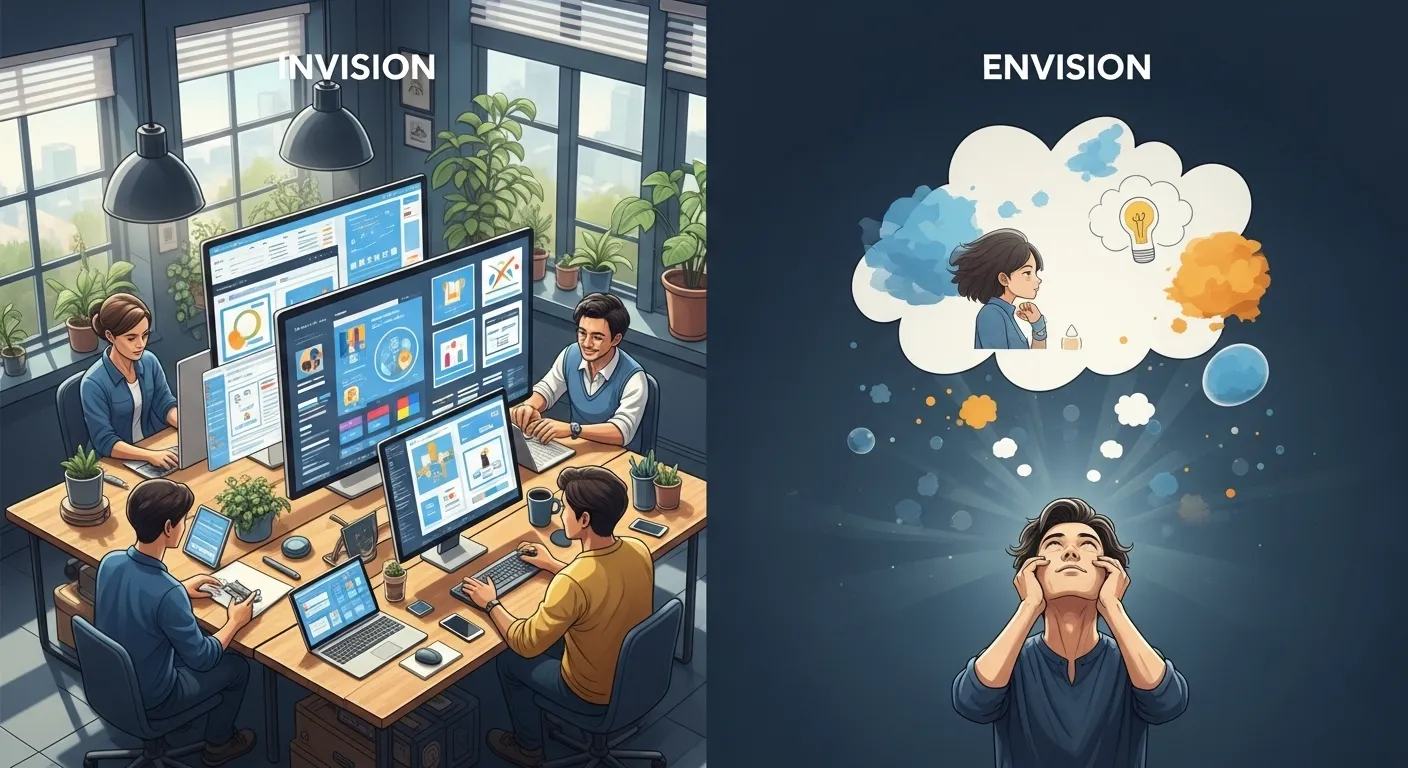
Have you ever wondered whether to write “invision” or “envision”? You are not alone. Many people struggle with these two spellings because they sound the same but are not always interchangeable.
If you type “invision” in a document or search engine, you might notice suggestions for “envision”. This confusion often arises in emails, articles, and business presentations.
Understanding the difference is essential for clear communication. Using the wrong spelling can make your writing look unprofessional.
People search for this keyword to clarify proper usage, especially in professional, educational, and creative contexts. In this article, we’ll explain which spelling is correct,
the origin of these words, the difference between British and American English, common mistakes, and examples of everyday usage. By the end, you’ll confidently know which form to use and why.
Invision or Envision – Quick Answer
The correct spelling is “envision.”
- Envision (verb) means: to imagine or visualize a future scenario or idea.
- Example: She could envision a world without pollution.
- Invision is a common misspelling and should generally be avoided. It is sometimes used as a brand name, but not in standard English.
- Example: Incorrect: “He tried to invision the solution.” → Correct: “He tried to envision the solution.”
Quick tip: If your context involves imagining or planning, always use envision.
The Origin of Invision or Envision
The word envision comes from the prefix “en-” meaning “to cause” and the Latin word “visionem” meaning “sight” or “vision.” Essentially, it means “to picture in the mind”.
- En- + vision → envision
- First recorded usage: early 17th century in English literature.
Invision, on the other hand, is not historically recognized in dictionaries. It has emerged mainly as a modern misspelling or as a brand/product name. Understanding the etymology clarifies why envision is correct in formal writing.
British English vs American English Spelling
Unlike words such as colour vs color or organisation vs organization, envision is spelled the same in both American and British English. There is no accepted variant invision in standard usage.
| Spelling | Region | Usage Example |
| Envision | US, UK, Global | I envision a better future for the company. |
| Invision | US/UK uncommon | Brand names or incorrect spelling; avoid in writing |
Key point: No regional difference exists. Using envision is always correct.
Which Spelling Should You Use?
- For American readers: Use envision in all professional and casual contexts.
- For British readers: Use envision; it is recognized internationally.
- Global audience: Stick with envision to avoid confusion.
Even if a company or product uses Invision as a name, when writing standard English, use envision.
Common Mistakes with Invision or Envision
- Using “invision” instead of “envision”
- ❌ I will invision the project timeline.
- ✅ I will envision the project timeline.
- Confusing with “imagine” or “picture”
- Imaging and envisioning are similar, but envision suggests planning or goal-setting.
- Capitalization errors
- Envision should not be capitalized unless starting a sentence or as a proper noun.
- Overusing synonyms
- Repeating envision too frequently in text can feel repetitive. Use visualize or imagine occasionally.
Invision or Envision in Everyday Examples
Emails:
- I envision our team completing the project ahead of schedule.
News articles:
- The government envisions a future with renewable energy for all cities.
Social media:
- We envision a community where everyone supports each other!
Formal writing:
- The company’s strategic plan envisions expansion into international markets by 2030.
Invision or Envision – Google Trends & Usage Data
According to Google Trends:
- Envision dominates searches globally.
- Invision appears mostly in brand/product searches.
- Highest searches for “envision” come from: US, UK, Canada, Australia, India.
Observation: Users searching for “invision vs envision” want spelling confirmation, not brand info. This makes it a high-intent SEO keyword.
Comparison Table – Keyword Variations Side by Side
| Word | Correct? | Definition | Example |
| Envision | ✅ Correct | To imagine or visualize | She envisions a bright future. |
| Invision | ❌ Incorrect (except brand) | Not standard English | He tried to invision the scene. |
FAQs
1. Can I use “invision” in professional writing?
No, envision is the standard form. Use “invision” only if referencing a brand.
2. Is “envision” British or American English?
It is accepted in both; there is no variant spelling.
3. What is the meaning of “envision”?
To picture, imagine, or mentally plan something.
4. Are “envision” and “imagine” interchangeable?
Sometimes, but envision is more formal and goal-oriented.
5. Why do people spell it “invision”?
Likely due to mishearing the word or seeing brand names with that spelling.
6. Can I use “invision” in creative writing?
It is not recommended; use envision to maintain credibility.
7. Is “envision” used in corporate contexts?
Yes, frequently in mission statements, business planning, and leadership discussions.
Conclusion
When it comes to invision or envision, the clear winner is envision. This word is universally accepted in both American and British English and conveys imagination, planning, and visualization.
Avoid invision, unless specifically referring to a brand or product. Using envision correctly can elevate your writing, emails, presentations, and social media posts, making you appear more professional and articulate.
Remember, proper spelling matters not just for grammar, but also for credibility.
Keep these points in mind:
- Envision = correct form, universally recognized.
- Invision = incorrect in standard English, acceptable only in branding.
- Always check context: business, education, or casual writing.
- Pair envision with words like plan, imagine, visualize for clarity.
By consistently using envision, you will avoid common mistakes and clearly communicate your ideas to any audience worldwid

David Szalay a British writer who focuses on modern life and relationships. His stories are simple but deep.