You are writing an email. You want to give an example. Or you want to explain something in simple words. You stop and think: should I use eg or ie?
Many writers face this problem every day. Students, bloggers, business owners, and professionals all see these short forms. They look similar. They sound similar. But they mean different things.
Using the wrong one can confuse readers. It can also make your writing look less professional. That is why people search for “eg or ie.” They want a clear answer. They want simple rules. They want examples they can trust.
The good news is this: the difference is easy once you learn it. Each one has one job. One gives examples. The other explains meaning.
In this guide, you will learn the quick answer, origin, examples, common mistakes, and expert advice. By the end, you will know exactly when to use eg or ie with confidence.
eg or ie – Quick Answer
Here is the simple rule:
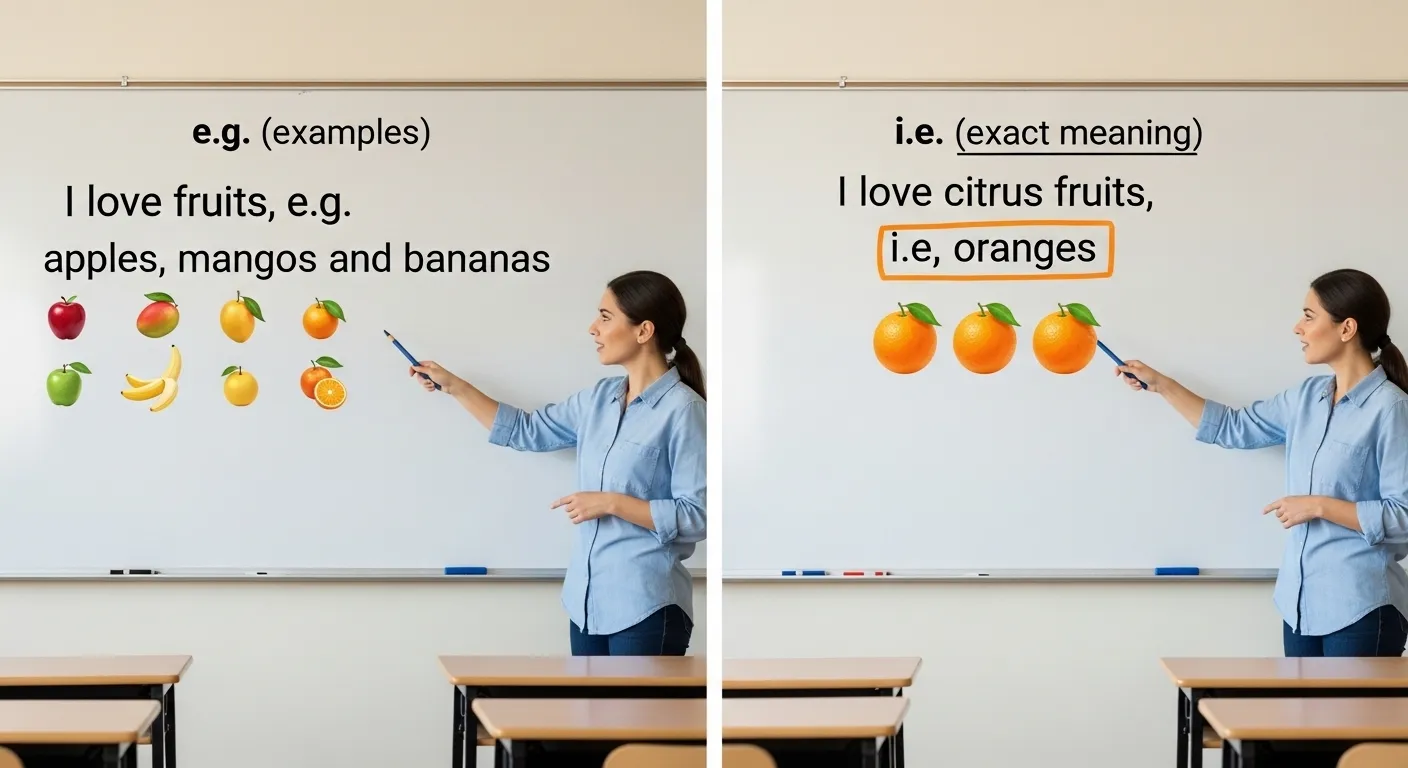
- eg means for example
- ie means in other words
Easy trick to remember
- eg = example given
- ie = in explanation
Examples
eg (for example)
I love fruits, eg apples, bananas, and mangoes.
(This gives examples of fruits.)
ie (in other words)
He is a vegetarian, ie he does not eat meat.
(This explains what vegetarian means.)
Short summary
| Abbreviation | Meaning | Use |
| eg | for example | Gives examples |
| ie | in other words | Explains meaning |
The Origin of eg or ie
Both eg and ie come from Latin. Latin was the language of scholars, law, and science.
- eg comes from exempli gratia
Meaning: for the sake of example - ie comes from id est
Meaning: that is
People used Latin in books and formal writing. Over time, writers shortened these phrases to eg and ie.
This made writing faster and easier.
Today, these short forms are common in:
- Emails
- Academic writing
- Business reports
- Blogs
- News articles
Even though Latin is old, eg and ie are still useful today.
British English vs American English Spelling
There is no spelling difference between eg and ie in British and American English. The letters stay the same.
The main difference is punctuation style.
American English style
In the United States, writers often use periods:
- e.g.
- i.e.
Example:
Bring snacks, e.g., chips and juice.
British English style
In the United Kingdom, writers may use periods or skip them:
- eg
- ie
Example:
Bring snacks, eg chips and juice.
Both are correct.
Comparison table
| Style | eg format | ie format | Example |
| American English | e.g. | i.e. | Foods, e.g., rice |
| British English | eg or e.g. | ie or i.e. | Foods, eg rice |
| Modern global style | eg | ie | Foods, eg rice |
Which Spelling Should You Use?
The best choice depends on your audience.
Use e.g. and i.e. for American readers
If your audience is in the United States, use:
- e.g.
- i.e.
This follows American style guides.
Use eg and ie for UK and Commonwealth readers
If your readers are in:
- United Kingdom
- Canada
- Australia
- Pakistan
You can use eg and ie without periods.
This style is common and accepted.
Use eg and ie for global audiences
If you write online, choose eg and ie. They look clean and modern. Most readers understand them.
Read More Combatting or Combating Which Spelling Is Correct?
Common Mistakes with eg or ie
Many writers confuse eg and ie. Here are the most common mistakes.
Mistake 1: Using eg when explaining
❌ He is a doctor, eg he works in a hospital.
✔ He is a doctor, ie he works in a hospital.
Explanation: This explains, not gives examples.
Mistake 2: Using ie when giving examples
❌ I like sports, ie football and cricket.
✔ I like sports, eg football and cricket.
Explanation: This gives examples.
Mistake 3: Thinking eg and ie mean the same
They do not mean the same.
- eg = examples
- ie = explanation
Mistake 4: Overusing them
Do not use them too often. Sometimes write full words instead.
Example:
Correct: I enjoy outdoor activities, for example hiking.
Also correct: I enjoy outdoor activities, eg hiking.
Mistake 5: Wrong punctuation
❌ eg apples bananas
✔ eg apples, bananas
Use commas to separate examples.
eg or ie in Everyday Examples
Here are real-life examples from daily writing.
Email example
Correct:
Please bring documents, eg your ID and passport.
Correct:
The meeting is mandatory, ie everyone must attend.
Business example
Correct:
We sell electronics, eg phones and laptops.
Correct:
This policy applies to full-time staff, ie permanent employees.
Social media example
Correct:
I love winter foods, eg soup and tea.
Correct:
She is an early bird, ie she wakes up at 5 AM.
News example
Correct:
Many countries, eg Japan and Germany, use advanced technology.
Correct:
The storm caused damage, ie many homes were destroyed.
Academic writing example
Correct:
Renewable energy sources, eg solar and wind, are growing.
Correct:
He is bilingual, ie he speaks two languages.
eg or ie – Google Trends & Usage Data
Search data shows that people often confuse eg and ie.
According to Google search patterns:
- “eg meaning” is searched often by students
- “ie meaning” is searched by professionals
- “eg vs ie” is popular worldwide
Popular regions
High usage in:
- United States
- United Kingdom
- Canada
- Australia
- Pakistan
Why people search this keyword
People want to:
- Avoid mistakes
- Write professionally
- Pass exams
- Improve grammar
- Write better emails
Both eg and ie remain popular in formal and informal writing.
Comparison Table: eg or ie Side by Side
| Feature | eg | ie |
| Full Latin form | exempli gratia | id est |
| Meaning | for example | in other words |
| Purpose | gives examples | explains meaning |
| Use case | lists examples | clarifies statement |
| Example sentence | I like fruits, eg apples | He is rich, ie very wealthy |
| Same as | for example | that is |
| Function | expands list | restates idea |
FAQs About eg or ie
1. What is the difference between eg and ie?
eg gives examples. ie explains meaning.
Example:
Pets, eg dogs
Pets, ie animals kept at home
2. Can eg and ie be used in emails?
Yes. They are common in emails and professional writing.
Example:
Send files, eg reports.
3. Should I use periods with eg and ie?
Both are correct.
- e.g., i.e. → American style
- eg, ie → British and modern style
4. Is eg informal or formal?
eg is used in both formal and informal writing.
It is common in:
- Academic writing
- Business writing
- Blogs
5. Can I use eg and ie in academic writing?
Yes. They are accepted in academic writing.
But follow your style guide.
6. Is it better to write “for example” instead of eg?
Both are correct.
Use “for example” in very formal writing.
Use eg for shorter writing.
7. Do eg and ie need commas?
Yes.
Example:
Bring items, eg books and pens.
Conclusion
The difference between eg or ie is simple but important. Both come from Latin. Both are used in modern writing. But they have different meanings and uses.
Use eg when you want to give examples. It helps readers see options or samples. Use ie when you want to explain or clarify something. It helps readers understand your exact meaning.
There is no spelling difference between British and American English. The only small difference is punctuation. American English often uses periods. British and global styles may skip them.
These abbreviations are useful in emails, academic writing, business reports, and online content. They save space and improve clarity.
To remember easily:
eg = example given
ie = in explanation
When you use them correctly, your writing becomes clearer, stronger, and more professional. With practice, choosing eg or ie will become natural and easy.

Andrew Michael Hurley is known for dark and atmospheric fiction. His stories often explore faith, fear, and isolation.