Many English learners and even native speakers often wonder: should it be “eaten” or “ate”? This confusion comes up in writing emails, social media posts, essays, and even casual texting.
Understanding the difference is crucial because using the wrong form can make your sentence grammatically incorrect.
People search for “eaten or ate” because these words are both past tense forms of “eat”, but they are used differently.
Choosing the correct word depends on grammar rules, sentence structure, and context. For instance, saying “I have ate breakfast” is wrong, while “I have eaten breakfast” is correct.
This article provides a clear explanation, origin, British vs American usage, common mistakes, examples in everyday life, and Google trends to help you confidently use “eaten” and “ate”.
By the end, you will know exactly when to use each word in your writing and speaking.
Read More Roku or Firestick – Which Streaming Device Is Better?
Eaten or Ate – Quick Answer
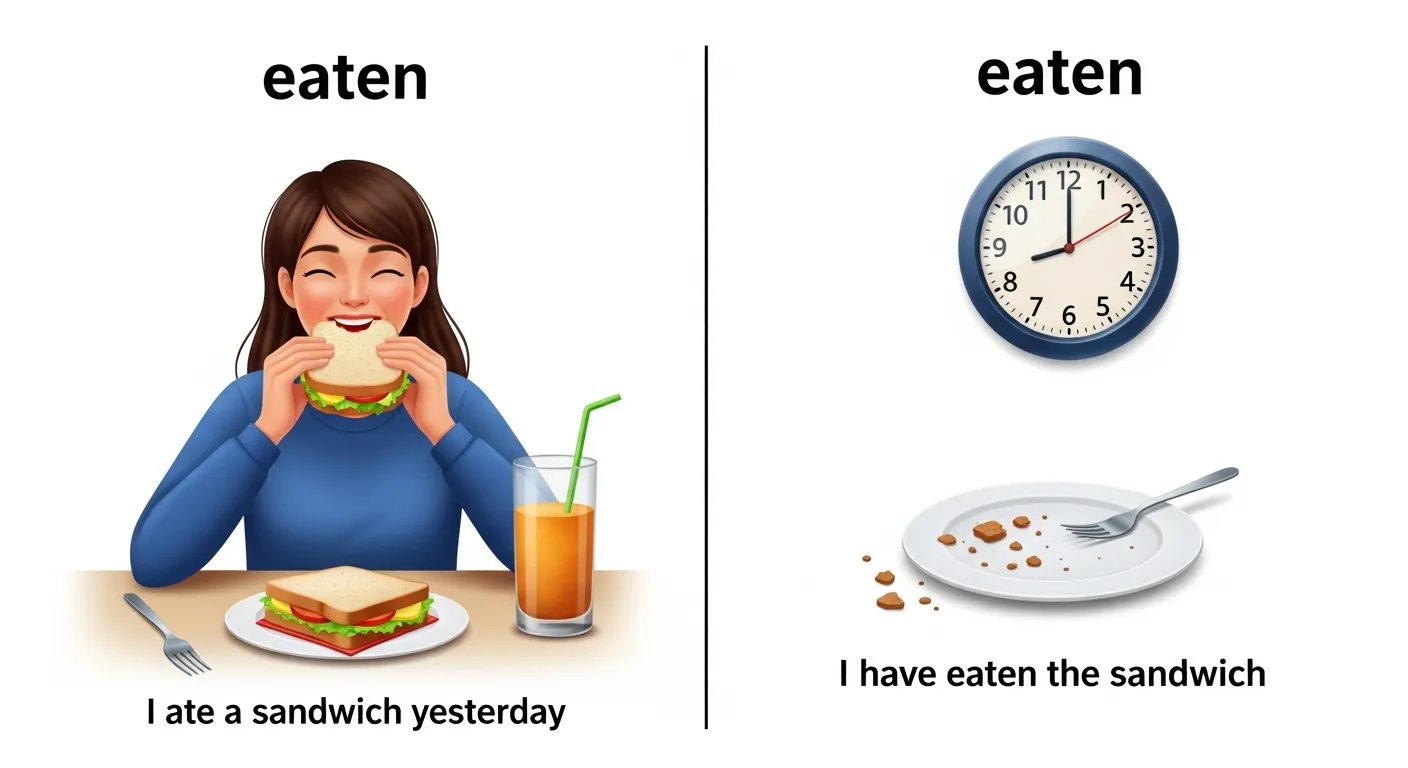
- Ate → Simple past tense of “eat.” Used when describing a completed action at a specific time.
- Example: I ate an apple yesterday.
- Eaten → Past participle of “eat.” Used with auxiliary verbs like have, has, or had.
- Example: I have eaten breakfast already.
Quick Tip: If you can replace the word with “have eaten” or “had eaten”, then “eaten” is correct. If not, use “ate.”
The Origin of Eaten and Ate
Both ate and eaten come from the Old English verb etan, which meant “to consume food.” Over time, English developed irregular past forms for strong verbs:
- Ate evolved as the simple past form.
- Eaten became the past participle form.
This irregular pattern is why English learners often get confused. Unlike regular verbs that just add -ed (like walk → walked), strong verbs like eat change vowels in different tenses:
- Present: eat
- Past: ate
- Past participle: eaten
The difference has remained consistent for hundreds of years, both in British and American English.
British English vs American English Spelling
When it comes to “eaten” and “ate”, there is no spelling difference between British and American English. Both forms are identical. However, differences appear in auxiliary verb usage and sentence preference in formal writing.
| Feature | British English | American English |
| Simple past | I ate breakfast. | I ate breakfast. |
| Present perfect | I have eaten lunch. | I have eaten lunch. |
| Preference | More common to use present perfect for recent past. | More flexibility; sometimes simple past is used instead. |
Example:
- UK: I have eaten already today.
- US: I ate already today. (acceptable in informal writing)
So, while spelling is the same, the grammatical preference can differ slightly.
Which Spelling Should You Use?
Since the spelling of eaten and ate is the same worldwide, your choice depends on grammar rules rather than location.
- US audience / informal writing: Simple past (ate) is often acceptable for recent actions.
- UK / Commonwealth / formal writing: Use present perfect (have eaten) for actions connected to the present.
- Global audience / professional writing: Follow standard grammar rules:
- Ate = simple past
- Eaten = past participle with auxiliary verbs
Tip: When writing for international readers, err on the side of correct grammar with eaten in combination with have, has, or had.
Common Mistakes with Eaten or Ate
Many mistakes occur when learners forget the auxiliary verb or mix tenses. Common errors include:
- Incorrect: I have ate breakfast.
Correct: I have eaten breakfast. - Incorrect: She eaten the cake yesterday.
Correct: She ate the cake yesterday. - Incorrect: Have you ate already?
Correct: Have you eaten already? - Incorrect: They had ate lunch before the meeting.
Correct: They had eaten lunch before the meeting.
Tip: Always pair eaten with have/has/had. If there is no auxiliary verb, use ate.
Eaten or Ate in Everyday Examples
Emails & Formal Writing
- Correct: I have eaten before the meeting, so I am ready.
- Incorrect: I ate before the meeting, so I am ready. (less formal)
Social Media & Casual Messaging
- I just ate pizza! 🍕 (perfectly fine)
- I have eaten pizza! (more dramatic / humorous tone)
News & Articles
- The president has eaten at the local diner. (formal / journalistic)
- The president ate at the local diner yesterday. (reporting simple past event)
Eaten or Ate – Google Trends & Usage Data
Google search trends show that “ate” is more commonly searched in casual contexts, while “eaten” appears in queries about grammar rules. Popular searches include:
- “Have eaten vs ate”
- “I have eaten breakfast”
- “When to use ate or eaten”
Top countries searching “eaten or ate”:
- United States
- United Kingdom
- Canada
- India
- Australia
This indicates strong global interest, mainly among English learners and writers.
Comparison Table – Eaten vs Ate
| Form | Function | Example | Notes |
| Ate | Simple past | I ate an apple yesterday. | Used alone, without auxiliary verbs. |
| Eaten | Past participle | I have eaten an apple. | Must use with have/has/had. |
| Ate | Informal US usage | I ate already today. | US speakers sometimes use simple past instead of present perfect. |
| Eaten | Formal writing | I have eaten already today. | Preferred in UK & formal contexts. |
FAQs About Eaten or Ate
1. Can I say “I have ate breakfast”?
No. The correct form is I have eaten breakfast. “Ate” cannot follow “have/has.”
2. Is “ate” only American English?
No, “ate” is standard in all English varieties. The difference is mostly in preference for present perfect vs simple past.
3. Can “eaten” be used alone?
No. It always requires an auxiliary verb: have, has, or had.
4. Which is more common in casual speech: ate or eaten?
“Ate” is more common in casual speech and text messaging.
5. Are there other irregular verbs like eat?
Yes. Examples: go → went → gone, see → saw → seen, take → took → taken.
6. Can I use “eaten” for past specific events?
Only with auxiliary verbs. For a specific past event without “have/has/had,” use “ate.”
7. How do I know which to use in emails?
If writing formally or professionally, prefer have eaten for recent past actions.
Conclusion
Understanding the difference between eaten and ate is simple once you remember the rules:
- Ate → simple past; use alone for actions completed at a specific time.
- Eaten → past participle; use with auxiliary verbs have, has, had for actions linked to the present or past.
While there is no spelling difference between British and American English, the preference for present perfect vs simple past can differ slightly. For casual conversation, ate is fine.
For professional writing, emails, or formal contexts, have eaten is the safest choice.
By using this guide, you can confidently write sentences like “I ate breakfast at 8 AM” or “I have eaten breakfast, so I’m ready for the meeting”, avoiding common grammar mistakes.
Understanding and practicing these forms will improve your writing clarity, correctness, and professionalism.

Claire Keegan an Irish author famous for powerful short stories. She writes in a clear and emotional style.