Do you ever get confused between capitol and capital? You’re not alone. Many English speakers struggle with these two words because they sound similar but have very different meanings.
One tiny spelling difference can change the meaning of your sentence entirely. This confusion is common in writing emails, reading news, or even in social media posts.
Understanding the difference matters, especially if you’re a student, professional writer, or just someone who wants to communicate clearly.
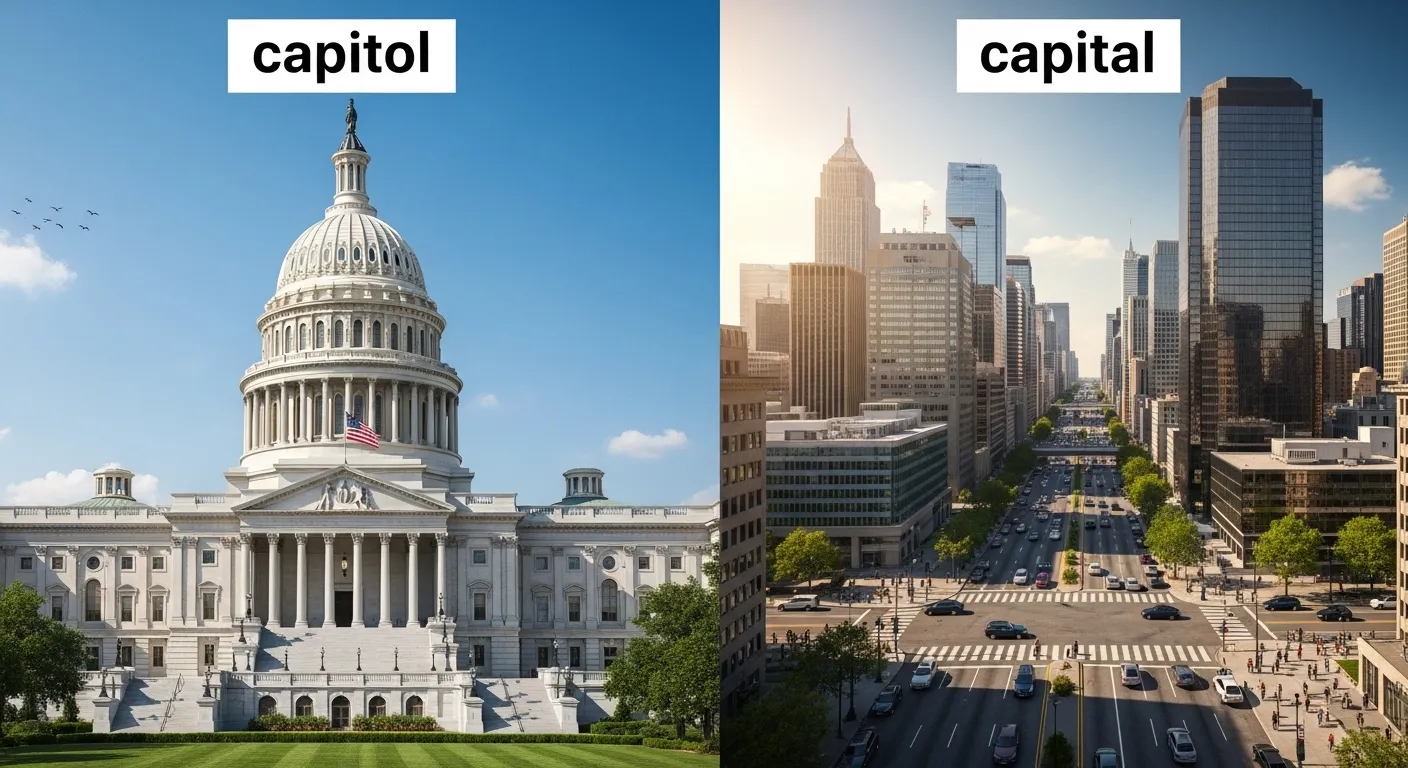
Capitol refers specifically to a building where legislators meet, whereas capital has multiple meanings: a city that serves as a government center, money or resources, and even uppercase letters in writing.
In this guide, we’ll break down the meanings, origins, common mistakes, and proper usage of both words. By the end, you’ll confidently know when to use capitol and capital, whether you’re writing formally or casually.
Capitol or Capital – Quick Answer
- Capitol – Refers to the building where a government legislature meets.
Example: The senators gathered at the Capitol to vote on the new law. - Capital – Can mean:
- A city where a government is based.
Example: Paris is the capital of France. - Money or resources used for investment.
Example: She invested her capital in a new startup. - Uppercase letters in writing.
Example: Always use a capital at the beginning of a sentence.
- A city where a government is based.
✅ Quick Tip: If you’re talking about a building, it’s Capitol with an “o.” For everything else, use capital with an “a.”
The Origin of Capitol or Capital
Both words share a Latin origin but evolved differently:
- Capitol comes from Capitōlium, the Latin name for the hill in ancient Rome where the main temple and government buildings were located. It specifically referred to a place of government or legislative power.
- Capital originates from the Latin word caput, meaning “head.” Over time, it extended to mean “head city” (government centre), “principal money” (financial head), and even “head letter” (uppercase).
The slight difference in spelling reflects this divergence in meaning over centuries. While both words are connected to “importance” (head or main), capitol became the word for government buildings, and capital developed broader uses.
British English vs American English Spelling
Interestingly, the distinction between capitol and capital is mostly an American convention. In British English, capital is used for all contexts:
| Word | American English | British English | Meaning |
| Capitol | Specific building | Rare / N/A | Government building |
| Capital | City, money, uppercase | City, money, uppercase | City, principal money, capital letters |
In the US, the Capitol usually refers to the specific building in Washington D.C., or state capitol buildings.- In the UK, you would write capital for both the city and financial meanings. “Capitol” is rarely used.
✅ Key takeaway: American English preserves the special “Capitol” spelling for government buildings, while British English sticks with “capital.”
Read More Sit or Seat: What’s the Difference and Which One Should You Use?
Which Spelling Should You Use?
- US Audience:
- Use Capitol only for legislative buildings.
- Use Capital for cities, money, or uppercase letters.
- UK / Commonwealth / Global Audience:
- Use capital in all cases.
- Avoid capitol unless referencing the US Capitol building specifically.
- Professional Writing Tip:
- When in doubt, think about context: building = capitol, everything else = capital.
Common Mistakes with Capitol or Capital
- Incorrect: I visited the capital today to see Congress.
Correct: I visited the Capitol today to see Congress. - Incorrect: London has a famous capitol building.
Correct: London has a famous capital city. - Confusing financial vs city context:
- Money: “She raised enough capital.” ✅
- City: “The capital of Italy is Rome.” ✅
- Uppercase letters confusion:
- “Always use a Capitol at the start of a sentence.” ❌
- Correct: “Always use a capital at the start of a sentence.” ✅
- Using capitol in British English for city or money: ❌
- Stick to capital unless referring to the US building.
Capitol or Capital in Everyday Examples
Emails:
- “The meeting will take place at the Capitol tomorrow.”
- “We need to raise more capital for our project.”
News:
- “Protesters gathered outside the Capitol building in Washington D.C.”
- “The nation’s capital is experiencing heavy traffic.”
Social Media:
- “Visiting the Capitol today was amazing! #DCTrip”
- “Investing your capital wisely is the key to success. #FinanceTips”
Formal Writing:
- Government reports: “The state legislature met at the Capitol.”
- Business reports: “The company plans to increase its capital investment in 2026.”
Capitol or Capital – Google Trends & Usage Data
Google Trends shows that:
- Searches for capital dominate globally, mostly for financial, city, and grammar topics.
- Capitol searches peak during political events or US government news.
Country Popularity:
- US: Both terms are commonly searched; context matters.
- UK / Canada / Australia: Mostly capital, rarely capitol.
- Global English learners: Many look for “capitol vs capital” to clarify spelling confusion.
This confirms that the words are context-dependent and highlights the importance of knowing your audience.
Capitol or Capital – Comparison Table
| Aspect | Capitol | Capital |
| Meaning | Government building | City, money, uppercase letter |
| Origin | Latin Capitōlium | Latin caput |
| US Usage | Specific to government | General |
| UK Usage | Rare | General |
| Example | The Capitol burned. | Paris is the capital. |
| Context | Politics / Law | Finance / Geography / Grammar |
FAQs – Capitol or Capital
- Q: Can I use “capitol” for any government building worldwide?
A: No, only in the US. Other countries use capital. - Q: Is “capital” correct for financial contexts?
A: Yes, money, resources, or investment are always capital. - Q: Do I capitalize “capitol” in a sentence?
A: Only when referring to the proper name, e.g., United States Capitol. - Q: Can “capital” mean both city and money?
A: Yes, context clarifies which meaning is intended. - Q: Is “capitol” ever used in British English?
A: Rarely. Use capital instead. - Q: How do I remember the difference?
A: “O” in capitol = Official building; “A” in capital = Any other meaning. - Q: Should I worry about SEO using these words?
A: Yes, use capitol when targeting US government searches and capital for general/global content.
Conclusion
Knowing the difference between capitol and capital can save you from embarrassing mistakes in writing and communication.
Remember, capitol with an “o” is exclusively for government buildings, mostly in the US. Capital with an “a” covers cities, money, resources, and uppercase letters.
When writing for an American audience, keep this distinction clear, especially in formal or professional content. For British or global English, stick to capital unless specifically referring to the US Capitol building.
Using the right word improves clarity, credibility, and reader trust.
Understanding origins, common mistakes, and real-world examples makes this rule easy to follow. Over time, differentiating capitol and capital will become second nature.
Keep this guide handy whenever you’re unsure it’s a quick reference for correct usage in writing, news, business, or social media.

Sarah Hall is an English novelist and short story writer. She often writes about nature, identity, and strong characters.