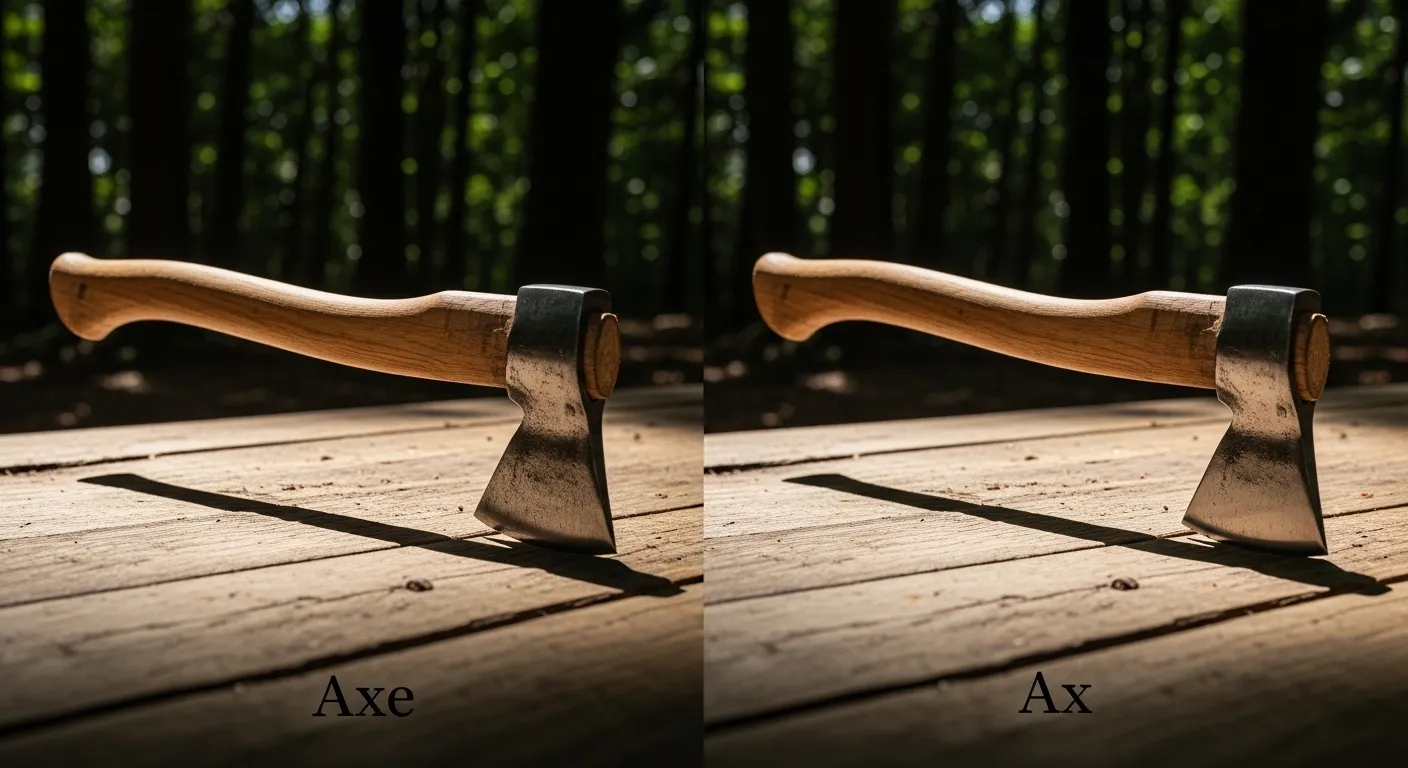
Have you ever wondered whether to write “axe” or “ax”? You’re not alone. Many people search this keyword because both spellings appear correct but they look different depending on where you are in the world.
This confusion often shows up in writing, blogging, schoolwork, and even product descriptions. For example, you might see fire axe in one place and fire ax in another. So which one is right?
The truth is simple: both spellings are correct, but they follow different regional rules. Understanding when to use each one helps you write clearly and professionally.
It also improves your SEO content, especially if you target a global audience.
In this guide, you’ll learn the difference between axe vs ax, their history, usage in British and American English, common mistakes, and real-world examples.
By the end, you’ll know exactly which spelling to use and when.
Axe or Ax – Quick Answer
Both “axe” and “ax” are correct spellings of the same word.
- “Axe” → Used in British English
- “Ax” → Used in American English
Examples:
- British: He chopped wood with an axe.
- American: He chopped wood with an ax.
👉 Meaning: A tool used for cutting wood, usually with a sharp metal blade.
The Origin of Axe or Ax
The word comes from the Old English word “æx”, which meant a cutting tool.
Over time:
- In British English, the spelling evolved into “axe”
- In American English, it was simplified to “ax”
This change happened because American English often prefers shorter spellings. Similar patterns appear in words like:
- colour → color
- favour → favor
So, both spellings come from the same root but changed based on language evolution and regional preferences.
British English vs American English Spelling
The difference between axe vs ax is mainly about location.
Key Differences:
| Feature | British English | American English |
| Spelling | Axe | Ax |
| Usage Region | UK, Australia, Canada | USA |
| Style | Traditional | Simplified |
| Example | Fire axe | Fire ax |
More Examples:
- British: The firefighter grabbed an axe.
- American: The firefighter grabbed an ax.
👉 Both are correct. The only difference is the audience.
Which Spelling Should You Use?
Choosing between axe and ax depends on your audience.
Use “axe” if:
- You write for UK or Commonwealth countries
- Your content follows British English rules
- You want a more traditional spelling
Use “ax” if:
- Your audience is in the United States
- You follow American English style guides
- You prefer shorter, simpler words
For Global Content:
If your audience is worldwide:
- Pick one style and stay consistent
- “Axe” is slightly more recognized globally
👉 Tip: Consistency matters more than choice.
Read more Sink or Swim: Understand the Meaning and Usage Clearly
Common Mistakes with Axe or Ax
Many writers make simple errors when using these words.
1. Mixing spellings
❌ He used an axe to cut wood with his ax.
✅ He used an axe to cut wood.
✅ He used an ax to cut wood.
👉 Stick to one spelling.
2. Thinking one is wrong
❌ “Ax” is incorrect spelling
✅ Both are correct
3. Using in wrong context
❌ He used an axe to write notes
✅ He used an axe to chop wood
👉 Remember: it’s a cutting tool.
4. Confusing with slang
In informal English:
- “Ax” can mean ask (slang)
Example:
- He will ax a question (informal)
👉 Avoid this in formal writing.
Axe or Ax in Everyday Examples
Here’s how the word appears in real life:
1. Emails
- Please bring an axe for the camping trip.
- Please bring an ax for the camping trip.
2. News
- The attacker carried an axe. (UK news)
- The attacker carried an ax. (US news)
3. Social Media
- Just bought a new axe for woodcutting 🔥
- Got a sharp ax today! 💪
4. Formal Writing
- The worker used an axe to cut logs.
- The worker used an ax to cut logs.
👉 Both are acceptable depending on region.
Axe or Ax – Google Trends & Usage Data
Search data shows interesting patterns:
- “Ax” is more popular in the United States
- “Axe” is more common in:
- United Kingdom
- Canada
- Australia
Usage Context:
- “Axe” often appears in:
- Literature
- Historical writing
- “Ax” appears more in:
- Product listings
- Tools and hardware content
👉 SEO Tip:
Use the spelling that matches your target country to improve rankings.
Comparison Table: Axe vs Ax
| Feature | Axe | Ax |
| Correct Spelling | Yes | Yes |
| Region | UK, Commonwealth | USA |
| Length | Longer | Shorter |
| Usage Style | Traditional | Modern |
| SEO Target | Global/UK | US audience |
FAQs
1. Is “axe” or “ax” correct?
Both are correct. The choice depends on British or American English.
2. Why do Americans use “ax”?
American English prefers shorter spellings, so “axe” became “ax.”
3. Which spelling is older?
“Axe” is closer to the original Old English form.
4. Can I use both in one article?
No. It looks unprofessional. Choose one and stay consistent.
5. Is “ax” informal?
No. It is standard in American English.
6. Which spelling is better for SEO?
Use:
- “Ax” for US traffic
- “Axe” for UK/global traffic
7. Does “ax” mean “ask”?
In slang, yes—but avoid using it in formal writing.
Conclusion
The difference between axe and ax is simple but important. Both words mean the same thing a tool used for cutting but their spelling depends on where you are and who you are writing for.
If your audience is in the United States, “ax” is the better choice. It is shorter and widely accepted.
On the other hand, if you write for the UK or other Commonwealth countries, “axe” is the preferred spelling. It follows traditional English rules and appears more often in formal writing.
For global content creators, the key is consistency. Choose one spelling style and use it throughout your content. This keeps your writing clear, professional, and easy to understand.
In the end, there is no “wrong” choice only the right choice for your audience. Once you understand this difference, you can confidently use either “axe” or “ax” in your writing without confusion.

Claire Keegan an Irish author famous for powerful short stories. She writes in a clear and emotional style.